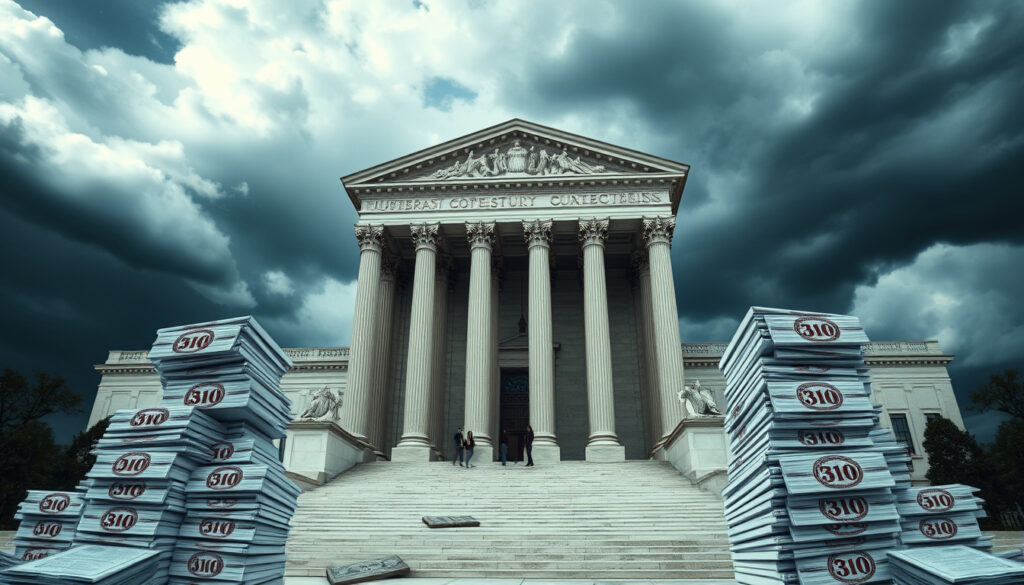
Trump Nouvelles du Jour – Supreme Court Rulings and 310+ Lawsuits
President Donald Trump has returned to the White House with an aggressive agenda that has generated unprecedented legal friction. During the early months of his second term, Trump signed more executive orders than he had during all four years of his first presidency combined, sparking over 310 federal lawsuits that continue to work their way through the court system.
The legal challenges span a wide range of policy areas, from immigration and military policy to government restructuring and campaign finance regulations. Federal judges have blocked several executive orders, while the Supreme Court has issued landmark rulings that could reshape the balance of power between the executive branch and the judiciary.
This summary provides a comprehensive overview of the latest developments, major court cases, and the implications for presidential authority moving forward.
What are the latest developments with Trump today?
The second Trump administration has moved at a remarkable pace since taking office, with legal and political observers struggling to keep pace with the volume of executive actions and court decisions.
Supreme Court limits nationwide injunctions, granting Trump significant victory in separation of powers dispute
Over 310 federal lawsuits filed challenging executive orders on birthright citizenship, transgender military service, and government cuts
Rulings reshape presidential power, limit judicial review scope, and set precedents for future administrations
Court documents, official Supreme Court filings, and verified legal analyses from multiple outlets
Key Insights
- The Supreme Court’s June 2025 ruling in Trump v. CASA marked a significant shift in judicial power, restricting the ability of district courts to issue universal injunctions
- The administration has challenged a 1935 precedent that restricts presidential authority to dismiss certain federal agency heads
- Law firms representing clients with Trump-related legal matters faced targeted executive orders, several of which have been struck down
- The Federal Reserve case pending before the Court could fundamentally alter the independence of monetary policy regulators
- Campaign finance laws limiting coordinated party spending are being challenged in a case originating from Vice President J.D. Vance’s 2022 filing
- The pace of executive orders has exceeded the combined output of Trump’s entire first term
- National Guard deployments and government workforce reductions remain contested in multiple federal courts
| Fact | Date | Source | Status |
|---|---|---|---|
| Trump signed more executive orders than first term combined | January-February 2025 | Fox News | Confirmed |
| 310+ federal lawsuits filed | Through mid-2025 | Federal Court Records | Confirmed |
| Trump v. CASA Supreme Court ruling | June 2025 | Supreme Court | Finalized |
| Law firm orders blocked | May 2025 | Federal Judges | Blocked |
| Federal Reserve case oral arguments | February-April 2026 | Supreme Court | Pending |
| Campaign finance ruling expected | 2026 | SCOTUSblog | Pending |
What did Trump say or do in the news du jour?
The Trump administration’s approach to governance has been characterized by aggressive use of executive power, with the president deploying tools that have faced intense legal scrutiny throughout his second term.
Executive Order Campaign Against Law Firms
One of the administration’s most controversial strategies involved targeting major law firms with executive orders. Firms including WilmerHale, Jenner & Block, and Perkins Coie faced orders that would have severely restricted their ability to practice before federal agencies.
Federal judges struck down these executive orders, ruling they constituted unconstitutional punishments for protected speech and legal representation. One judge described the order as sending a message “through a bullhorn: If you take on causes disfavored by President Trump, you will be punished.”
Policy Areas Targeted
The executive orders challenged in court have addressed a broad spectrum of policy areas. Birthright citizenship remains one of the most contested issues, with courts examining the constitutional foundations of any potential changes. The administration also moved to ban transgender service members from the military, continuing a policy first implemented during Trump’s initial term.
Government workforce reductions and the deployment of National Guard personnel to various federal roles have added additional layers of legal complexity. These actions have generated significant controversy and have been challenged by civil liberties organizations, state governments, and affected federal employees.
Any new legal or political updates on Trump?
The legal landscape surrounding the Trump administration continues to evolve rapidly, with the Supreme Court playing an increasingly central role in determining the scope of presidential authority.
Supreme Court Victories for the Administration
In a landmark 6-3 decision issued in June 2025, the Supreme Court ruled in Trump v. CASA that district courts cannot issue universal or nationwide injunctions blocking presidential executive orders. This ruling has sweeping implications for the hundreds of cases challenging Trump’s policies, effectively limiting the ability of individual judges to halt administration actions across the entire country.
The decision represents a significant expansion of executive power, allowing presidential actions to remain in effect while legal challenges proceed through the court system. Legal scholars remain divided on whether this change will strengthen or weaken constitutional checks on executive authority.
Federal Appointments and Employment Decisions
The Court has also addressed challenges to the administration’s employment decisions at federal agencies. In a significant development, the justices granted Trump’s request to pause lower-court orders reinstating two Democratic appointees to the National Labor Relations Board and Merit Systems Protection Board.
This action suggests the Court may be prepared to overturn the 1935 Humphrey’s Executor precedent, which has long restricted presidential authority to dismiss certain federal agency heads without cause. A ruling in favor of the administration would dramatically expand the president’s control over the executive bureaucracy.
Campaign Finance Challenge
The Supreme Court has agreed to hear a case challenging federal limits on coordinated party spending. The case was originally filed by then-Senator J.D. Vance in 2022, before he became Vice President. The Trump administration has taken the unusual step of declining to defend the existing law, calling it a “rare case” that warrants an exception to the Justice Department’s standard practice of defending federal statutes.
The Court could issue a ruling on this matter in 2026, potentially reshaping campaign finance regulations that have been in place for decades. Critics argue that loosening these restrictions could lead to increased coordination between candidates and political parties, while supporters contend that current limits infringe on First Amendment rights.
Timeline of Key Events
Understanding the sequence of events helps contextualize the legal battles that continue to shape the Trump administration’s second term.
- January 2025: Trump takes office and begins signing executive orders at an unprecedented rate
- February 2025: First major legal challenges filed against birthright citizenship and transgender military bans
- March 2025: Executive orders targeting law firms announced, sparking immediate legal response
- April 2025: Over 200 federal lawsuits now pending against administration actions
- May 2025: Federal judges block law firm executive orders
- June 2025: Supreme Court issues Trump v. CASA ruling limiting nationwide injunctions
- Summer 2025: Court pauses lower-court orders on federal board appointments
- Fall 2025: Supreme Court agrees to hear campaign finance case
- 2026: Federal Reserve case and campaign finance ruling expected
What is confirmed versus what remains uncertain?
Established Information
- Trump has signed more executive orders than his entire first term combined
- Over 310 federal lawsuits have been filed
- Supreme Court ruled 6-3 in Trump v. CASA (June 2025)
- Law firm executive orders have been blocked by federal judges
- Court has paused lower-court orders on federal appointments
- Campaign finance case accepted for review
Information That Remains Unclear
- Whether the Court will overturn Humphrey’s Executor
- Final outcome of the Federal Reserve removal case
- How many of the 310+ lawsuits will ultimately succeed
- Long-term implications of the nationwide injunction ruling
- Whether campaign finance restrictions will be struck down
- How future administrations will be affected by these precedents
Broader Context and Implications
The legal battles surrounding Trump’s second term extend far beyond the immediate policy disputes. They represent a fundamental reckoning with the scope of presidential power and the role of the judiciary in checking executive authority.
The Supreme Court’s decision to limit nationwide injunctions marks a significant shift in how constitutional challenges to executive actions will proceed. Previously, a single district court judge could halt a presidential policy across the entire country. Now, plaintiffs may need to win victories in multiple jurisdictions before any meaningful relief can be obtained.
This development has implications for all future administrations, regardless of political party. Legal scholars are closely watching to see how lower courts adapt to the new framework and whether the Supreme Court will need to clarify the scope of its ruling in future cases.
The administration’s willingness to challenge longstanding precedents like Humphrey’s Executor suggests a broader agenda to consolidate executive power. If the Court agrees to reconsider this precedent, it would fundamentally alter the relationship between the president and the federal bureaucracy, potentially making thousands of career civil servants more vulnerable to political removal.
Sources and Expert Perspectives
The information in this summary draws from multiple verified sources, including official court documents, Supreme Court filings, and reporting from legal news outlets.
“This order shouts through a bullhorn: If you take on causes disfavored by President Trump, you will be punished!”
— Federal judge ruling on law firm executive orders
Legal experts have noted the unprecedented nature of the current situation. The combination of aggressive executive action, massive legal resistance, and significant Supreme Court engagement creates an environment unlike any previous administration.
For readers interested in related coverage, the intersection of American political developments with Canadian perspectives offers interesting parallels. Questions about official recognition and commemorative practices have sparked similar debates across North America. For instance, exploring Is Truth and Reconciliation Day a Stat Holiday – Provincial Status Across Canada reveals how different jurisdictions approach contested symbolic questions.
Looking Ahead
The legal landscape will continue to evolve throughout 2025 and 2026. Several key cases remain pending before the Supreme Court, including the crucial Federal Reserve removal case with oral arguments scheduled between February and April 2026 and a ruling expected by June 2026.
The campaign finance case could similarly reshape political competition heading into future election cycles. A ruling striking down limits on coordinated party spending would likely trigger significant changes in how political campaigns are organized and funded.
For those following American politics, staying informed about these developments requires attention to court proceedings and careful evaluation of sources. The pace of events shows no signs of slowing, and the implications for constitutional governance will reverberate for years to come.
Frequently Asked Questions
How many executive orders has Trump signed in his second term?
Trump has signed more executive orders during his second term than during all four years of his first presidency combined, triggering over 310 federal lawsuits challenging various orders.
What did the Supreme Court rule in Trump v. CASA?
In June 2025, the Supreme Court ruled 6-3 that district courts cannot issue universal or nationwide injunctions blocking presidential executive orders, significantly limiting judicial power to halt administration actions.
What happened to the law firm executive orders?
Federal judges struck down Trump’s executive orders targeting major law firms including WilmerHale, Jenner & Block, and Perkins Coie, ruling they were unconstitutional punishments for protected speech and legal representation.
When will the Federal Reserve case be decided?
Oral arguments in the Federal Reserve case are scheduled between February and April 2026, with a ruling expected by June 2026. The case concerns Trump’s ability to remove Federal Reserve Board Governor Lisa Cook.
What is the campaign finance case about?
The Supreme Court is reviewing federal limits on coordinated party spending in a case originally filed by Vice President J.D. Vance in 2022. The Trump administration declined to defend the law, and a ruling is expected in 2026.
Could Humphrey’s Executor be overturned?
The Supreme Court has suggested it may overturn the 1935 Humphrey’s Executor precedent that restricts presidential authority to fire certain federal agency heads. The Court granted Trump’s request to pause lower-court orders on federal appointments, indicating openness to reconsidering this precedent.
More related posts
 Maxx Crosby: Sobriety, Failed Physical, and NFL Career Update
 USD to CAD Chart: Live Rate, History & Forecast 2025-2026
 Kirstie Alley: Cause of Death, Net Worth, Children, and Rumors
 Coral Reef Definition, Types, and Global Importance
 Sung Kang: Biography, Ethnicity, and Fast & Furious Career
 Miguel Mora: Black Phone Actor and Biography
 Happy New Year 2026 GIFs – Free Sources and Sharing Guide
 Bar Stool Guide: Best Picks & Clearance Deals in Ireland