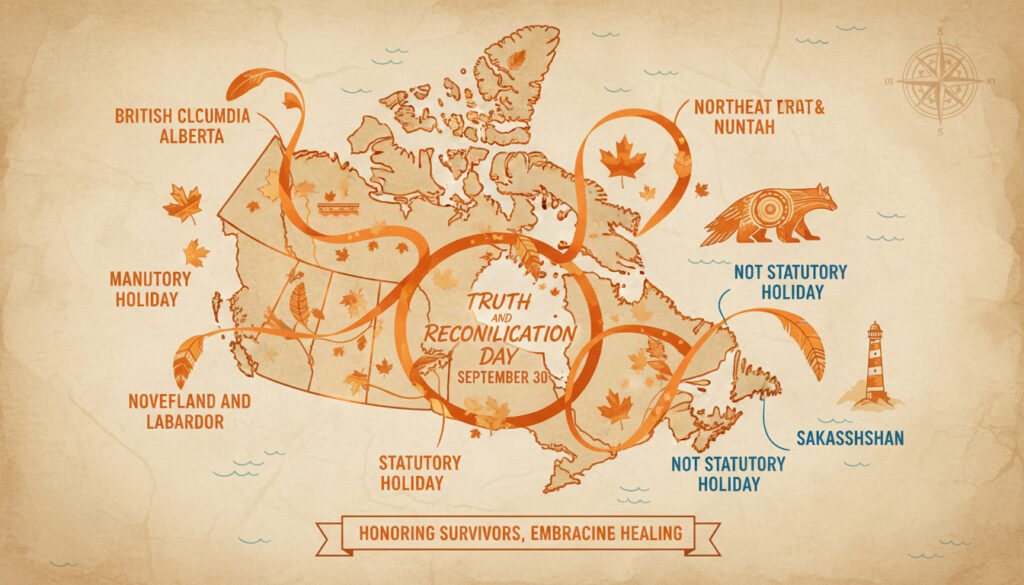
Is Truth and Reconciliation Day a Stat Holiday – Provincial Status Across Canada
September 30 marks the National Day for Truth and Reconciliation in Canada, a date designated to honor residential school survivors and commemorate the children who never returned home. Since its federal designation in 2021, workers across the country have questioned whether this observance carries statutory holiday status in their specific jurisdiction.
The answer depends entirely on where you work and who employs you. While federal employees and workers in federally regulated industries observe September 30 as a paid statutory holiday, provincial recognition remains inconsistent, creating a patchwork of entitlements that shifted through 2023 and holds steady into 2025.
Understanding your rights requires examining both federal labour codes and your specific provincial employment standards, as these jurisdictions operate independently when designating public holidays.
Is Truth and Reconciliation Day a Statutory Holiday?
Yes, but only within specific parameters. The National Day for Truth and Reconciliation functions as a statutory holiday exclusively for federal government employees and workers in federally regulated private-sector industries, a status established through amendments to the Canada Labour Code in 2021. For the broader Canadian workforce, statutory recognition varies significantly by province and territory.
Date
September 30 annually
Federal Status
Statutory holiday for federal sector employees
Provincial Scope
Varies by jurisdiction; mandatory in some, optional in others
Legal Basis
TRC Call to Action 80; Canada Labour Code amendments
Essential Facts About Holiday Status
- Federally mandated since 2021, fulfilling the Truth and Reconciliation Commission’s Call to Action 80
- Applies to federal public service, banks, airlines, telecommunications, and other federally regulated industries
- Not universally statutory across provincially regulated workplaces
- Employment standards jurisdiction determines whether private-sector workers receive paid time off
- Schools and public sector operations may close even in provinces without full statutory designation
- Status remained consistent through 2024 and 2025 with no reported reversals
- Originally observed as Orange Shirt Day before federal recognition
| Aspect | Details |
|---|---|
| Established | 2021 (first observed September 30, 2021) |
| Annual Date | September 30 |
| Federal Status | Statutory for federal employees and regulated industries |
| Ontario | Not statutory; optional via employer policy |
| British Columbia | Statutory since March 2023 |
| Alberta | Optional; commemorated but not mandated |
| Manitoba | Statutory since 2023 |
| Prince Edward Island | Statutory for all workers |
| Northwest Territories | Statutory since June 2022 |
| Nunavut | Statutory since August 2022 |
| Yukon | Statutory since November 2022 |
| Pay Entitlement | Varies by jurisdiction and employer classification |
Which Provinces and Territories Recognize It as a Stat Holiday?
Provincial adoption of the National Day for Truth and Reconciliation as a statutory holiday accelerated between 2022 and 2023, though several major jurisdictions maintain optional status. The recognition pattern reflects responses to the 2021 discoveries of unmarked graves at former residential school sites, prompting legislative action in multiple provinces.
Full Statutory Recognition
British Columbia, Manitoba, and Prince Edward Island mandate paid time off for eligible workers under provincial employment standards. British Columbia amended its Employment Standards Act in March 2023, bringing the province into alignment with federal recognition. Manitoba followed suit with province-wide legislation in 2023, while Prince Edward Island maintained statutory status since the holiday’s inception.
The three northern territories—Northwest Territories, Nunavut, and Yukon—each enacted statutory provisions between June 2022 and November 2022, ensuring all workers in these jurisdictions receive the day off with pay or premium pay for required work.
Limited or Partial Recognition
New Brunswick and Nova Scotia limit statutory recognition to provincial government employees. While public servants and schools close in these provinces, private-sector employers operate under normal employment standards unless collective agreements specify otherwise.
Optional Commemoration
Alberta and Ontario represent the largest jurisdictions without statutory mandates. In Alberta, employers independently determine whether to observe the day. Ontario similarly maintains optional status, meaning workers rely entirely on employer discretion or union agreements to receive paid leave.
Workers in Alberta and Ontario should consult their employment contracts or human resources departments, as private companies in these provinces are not legally required to provide paid time off for September 30. Public sector employees may still receive the holiday despite provincial private-sector exemptions.
Federal vs. Provincial Holiday Status
The division of labour jurisdiction in Canada creates distinct categories of workers with different entitlements. Understanding whether your employer falls under federal or provincial regulation determines your holiday status regardless of your physical location.
Federally Regulated Industries
The Canada Labour Code covers approximately 6% of Canadian workers, including employees in banking, air and rail transportation, telecommunications, and certain Crown corporations. These workers automatically receive September 30 as a paid statutory holiday. The Canada Revenue Agency confirmed this status extending through 2026, indicating long-term federal commitment to the observance.
Provincial Employment Standards
Provincially regulated employers—including most retail, hospitality, construction, and healthcare workers—follow local employment standards legislation. Where the holiday holds statutory status, employers must provide a paid day off or premium pay (typically 1.5 to 2 times regular wages) for employees required to work.
In jurisdictions where Truth and Reconciliation Day holds statutory status, pay calculations follow the same formulas as other provincial holidays such as Labour Day or Thanksgiving. Workers receiving the day off with pay must have worked the scheduled day before and after the holiday, or provided reasonable notice if absent.
Mixed Jurisdiction Scenarios
Employees of federal companies working in provincially regulated roles may encounter confusion. A bank branch in Alberta, for instance, closes because banking falls under federal jurisdiction, even though Alberta does not mandate the holiday for provincially regulated businesses. Conversely, a provincially regulated business in British Columbia must close or pay statutory holiday rates because British Columbia recognizes the day province-wide.
How Did Truth and Reconciliation Day Become a Statutory Holiday?
The path to statutory recognition spans nearly a decade, originating from the Truth and Reconciliation Commission’s final recommendations and accelerating following significant national events.
- 2015: The Truth and Reconciliation Commission releases its final report including 94 Calls to Action, with Call to Action 80 specifically requesting a federal statutory commemoration day.
- 2020–2021: Federal legislation amends the Canada Labour Code, establishing September 30 as the National Day for Truth and Reconciliation. The first observance occurs on September 30, 2021.
- 2021: Early provincial adopters including Yukon, Nova Scotia, Prince Edward Island, and Manitoba recognize the day for public sector workers, though not necessarily for all private-sector employees.
- 2022: The Northwest Territories (June), Nunavut (August), and Yukon (November) enact full statutory provisions covering all workers within their jurisdictions.
- 2023: British Columbia (March) and Manitoba expand recognition to include all provincially regulated workers, not just public servants. New Brunswick and Nova Scotia maintain limited recognition for government employees only.
- 2024–2025: Status quo maintains existing statutory designations with no provinces reversing recognition or adding new mandates beyond those established in 2023.
What Do We Know for Certain?
The legal landscape surrounding this holiday contains both established facts and continuing uncertainties that affect worker planning and employer compliance.
Established Information
- Federal statutory status remains secure through 2026
- BC, Manitoba, PEI, and all three territories mandate the holiday for all workers
- Alberta and Ontario do not require private employers to observe the day
- Schools typically close nationwide regardless of private-sector status
- The date coincides with Orange Shirt Day commemorations
Remaining Uncertainties
- Quebec and Saskatchewan legislative intentions remain unspecified in available sources
- Future provincial adoptions beyond 2023 cannot be predicted
- Specific eligibility criteria vary by provincial employment standards boards
- Collective agreement interpretations may create exceptions in unionized workplaces
What Is the Historical Significance of September 30?
Before federal recognition, September 30 served as Orange Shirt Day, originating from Phyllis Webstad’s experience having her new orange shirt taken away on her first day at a residential school. The color orange became a symbol of the stripping away of Indigenous culture, identity, and belongings that occurred within the residential school system.
The National Day for Truth and Reconciliation specifically honors survivors of the 139 former residential schools recognized under the Indian Residential Schools Settlement Agreement, as well as the children who disappeared or died while institutionalized. The federal government maintains that the day responds to Call to Action 80, which sought to establish a statutory holiday to “honour Survivors, their families, and communities, and ensure that public commemoration of the history and legacy of residential schools remains a vital component of the reconciliation process.”
Financial institutions and government offices closing on this day reflect not merely administrative observance but recognition of the economic dimensions of reconciliation. Workers seeking to understand how statutory holidays affect their financial planning might consult resources like the Northern Credit Union Login – Secure MemberDirect Guide for banking availability information during holiday periods.
Because banking falls under federal jurisdiction, financial institutions close on September 30 nationwide, regardless of provincial statutory status. This affects payroll processing times and branch availability even in provinces where the day is not a statutory holiday for other industries.
What Do Official Sources Say About Holiday Status?
Government communications emphasize the educational and commemorative purposes of the observance alongside its legal status as a holiday.
“The National Day for Truth and Reconciliation is a day for all Canadians to commemorate the history and legacy of the residential school system.”
— Government of Canada
“This is an opportunity for each public service employee to personally commemorate the National Day for Truth and Reconciliation, whether through formal organized events or personal reflection.”
— Treasury Board of Canada Secretariat
Provincial labour ministries provide specific guidance regarding employment standards. Nova Scotia’s Labour Standards Code, for instance, clarifies that while provincial government offices close, the day does not carry the same statutory requirements as Canada Day or Christmas for private employers.
What Should Workers Understand About Their Rights?
Statutory holiday entitlements on September 30 remain fixed into 2025 based on 2023-2024 legislative patterns. Federal employees and those in regulated industries can rely on paid time off. Workers in British Columbia, Manitoba, Prince Edward Island, and the three territories enjoy similar protections under provincial and territorial law. Elsewhere, particularly in Alberta and Ontario, employees should verify specific employer policies, as the day remains optional for private businesses. Those navigating financial implications of holiday pay or planning international transactions during this banking holiday may find the 20000 CAD to INR – Current Rate and Conversion Guide useful for understanding currency exchange timing around statutory closures.
Frequently Asked Questions
When exactly is Truth and Reconciliation Day observed?
The National Day for Truth and Reconciliation occurs annually on September 30. If this date falls on a weekend, observance rules vary by jurisdiction regarding Monday substitution.
Why was September 30 chosen for this national observance?
The date aligns with Orange Shirt Day, commemorating the experience of Phyllis Webstad at St. Joseph’s Residential School. The orange shirt represents the stripping away of Indigenous identity and culture.
Do retail stores have to close on September 30?
Closure requirements depend on provincial statutory status and local retail business legislation. In BC, Manitoba, and PEI, retail operations face the same restrictions as other statutory holidays. In Ontario and Alberta, stores may operate normally.
Will I receive holiday pay if I work on September 30?
In jurisdictions where the day holds statutory status, working on September 30 requires payment at premium rates (typically 1.5x or 2x regular wages) plus regular holiday pay, or an alternative day off. In non-statutory provinces, standard wages apply unless employer policy dictates otherwise.
Are schools open on Truth and Reconciliation Day?
Public schools generally close nationwide on September 30, even in provinces where the day is not a statutory holiday for private-sector workers. This reflects the day’s educational and commemorative significance.
Does the holiday apply to part-time or casual employees?
Statutory holiday eligibility typically requires working a minimum number of days or hours preceding the holiday, usually determined by provincial employment standards. Part-time employees meeting these thresholds qualify for holiday pay in statutory jurisdictions.
What happens if September 30 falls on a weekend?
Federal and provincial rules vary regarding weekend holidays. Some jurisdictions move the observance to the preceding Friday or following Monday, while others maintain the specific date without substitution.
More related posts
 Kung Fu Panda 2: Plot, Cast, Streaming & Hit Status
 Ben Stiller: Health, Wife, Nepo Baby, and Career Evolution
 50 Grams to Cups: Flour, Butter, Water Conversions
 Jeep Wrangler for Sale in Ireland: Best Years & Deals
 Spencer Lofranco Dies at 33, Cause Still Under Investigation
 Toronto Blue Jays vs Red Sox Match Player Stats: 3-0 Shutout
 What Happened to Jeremy Meeks? From Bae to Model and Father