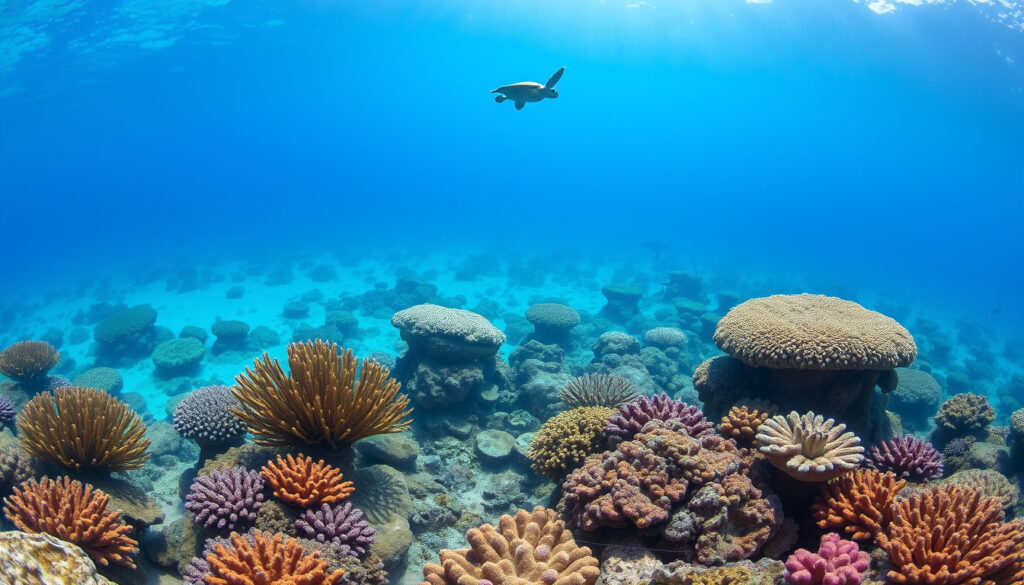
Coral Reef Definition, Types, and Global Importance
Most people picture a coral reef as a sun-drenched tropical scene. But some of the most remarkable reefs lie in cold, dark waters off the coast of Ireland, at depths reaching a kilometre down. This guide explains what a coral reef really is, breaks down the four main types, and explores why cold-water reefs matter just as much as their warm-water cousins.
Approximate number of coral species worldwide: 800 ·
Percentage of marine life dependent on coral reefs at some stage: 25% ·
Estimated economic value of coral reefs per year (USD): $375 billion ·
Depth range of cold-water corals off Ireland: 600-1000 meters
Quick snapshot
- Underwater ecosystem built by coral polyps (National Parks & Wildlife Service (Irish government agency))
- Held together by calcium carbonate skeletons (National Parks & Wildlife Service (Irish government agency))
- Found in warm and cold waters (MARUM (University of Bremen research centre))
- Fringing reef (NOAA Office of Ocean Service (US federal agency))
- Barrier reef (NOAA Office of Ocean Service (US federal agency))
- Atoll (NOAA Office of Ocean Service (US federal agency))
- Patch reef (NOAA Office of Ocean Service (US federal agency))
- Great Barrier Reef (Australia) — largest (Great Barrier Reef Foundation)
- Belize Barrier Reef — second largest (Belize Tourism Board)
- Red Sea Coral Reef — third largest (World Wildlife Fund (global conservation NGO))
- Irish cold-water reefs (600–1000 m deep) (Irish Marine Institute (state agency))
- Home to 25% of marine species (World Wildlife Fund (global conservation NGO))
- Coastal protection from storms (NOAA (US federal marine agency))
- Economic value in tourism and fisheries ($375 billion/year) (NOAA (US federal marine agency))
Six core facts, one pattern: coral reefs are not just tropical — they span depths, climates, and ocean basins with striking diversity.
| Fact | Details |
|---|---|
| Formed by | Colonies of coral polyps (National Parks & Wildlife Service (Irish government agency)) |
| Main structural material | Calcium carbonate (NPWS (Irish government agency)) |
| Number of reef types | Four (fringing, barrier, atoll, patch) (NOAA Office of Ocean Service (US federal agency)) |
| Largest reef system | Great Barrier Reef (2,300 km) (Great Barrier Reef Foundation) |
| Irish cold-water reef depth | 600–1000 meters (Irish Marine Institute (state agency)) |
| Percentage of marine life supported | 25% (World Wildlife Fund (global conservation NGO)) |
What exactly is a coral reef?
A coral reef is an underwater ecosystem built by colonies of coral polyps held together by calcium carbonate skeletons. The National Parks & Wildlife Service explains that reefs can be biogenic — formed by living organisms — or non-biogenic, built on rocky substrate.
How are coral reefs formed?
- Larval corals settle on a hard surface and secrete calcium carbonate.
- Over centuries, new polyps build atop dead predecessors, creating the reef structure.
- The NPWS notes that both biogenic and non-biogenic types exist in Irish waters.
Coral reefs are often called “rainforests of the sea” — they cover less than 1% of the ocean floor but support an estimated 25% of all marine species. For Ireland, that means cold-water reefs are just as ecologically critical as tropical ones.
The implication: understanding reef formation helps explain why even deep, dark waters off Ireland can host thriving ecosystems built on calcium carbonate foundations.
What are reef-building corals?
- Hard corals (scleractinians) are the primary builders because they deposit calcium carbonate.
- Cold-water builders include Lophelia pertusa and Madrepora oculata (National Parks & Wildlife Service (Irish government agency)).
- Warm-water reefs rely on symbiotic algae (zooxanthellae) for energy; cold-water corals filter-feed.
What this means: The definition of a coral reef is broader than most realise. Cold-water reefs off Ireland at 600–1000 m depth are built by different species but function as equally rich habitats.
What are the 4 types of coral reefs?
Scientists classify coral reefs into four main types based on their shape and relationship to land. The pattern is well established: fringing, barrier, atoll, and patch.
What is a fringing reef?
- Grows directly from the shore, like a submerged terrace.
- Common around islands and along coastlines.
- Example: reefs along the Red Sea coast.
What is a barrier reef?
- Separated from land by a deep lagoon.
- The largest is the Great Barrier Reef (2,300 km long).
- Second largest: Belize Barrier Reef (MARUM (University of Bremen research centre)).
What is an atoll?
- Ring-shaped reef enclosing a central lagoon.
- Forms when a volcanic island subsides and coral grows upward.
- Common in the Pacific and Indian Oceans.
What is a patch reef?
- Small, isolated coral formation, often within a lagoon or on a platform.
- Can be scattered across shallow areas.
The pattern: These four types cover nearly all reef geometries, but cold-water reefs don’t fit neatly — Ireland’s deep reefs are mound-like structures on the continental slope, not classic fringing or barrier forms.
Are there any coral reefs in Ireland?
Yes — and they are cold-water reefs composed mainly of Lophelia pertusa coral, thriving at depths of 600–1000 m off the west coast. The Irish Marine Institute describes them as “growing slowly in the dark Atlantic, hundreds of metres below the surface.”
What are cold-water corals?
- Cold-water corals lack symbiotic algae and filter food particles from the water.
- The University Times reports that over half of the world’s coral species are cold, deep-water species.
- Key Irish species: Lophelia pertusa and Madrepora oculata.
Cold-water reefs grow extremely slowly — millimetres per year — and are highly vulnerable to bottom trawling. Hall-Spencer et al. documented widespread trawling damage to Irish cold-water reefs at depths of 840–1300 m (Marine Scotland (Scottish government consultation)).
Where are Ireland’s deep-water coral reefs?
- A 2009 expedition discovered a cold-water coral province covering about 200 sq km off the west coast (CORDIS (EU research information service)).
- That province contains about 40 coral-covered mounds rising up to 100 m above the seabed (CORDIS).
- The Marine Institute later reported the deepest known occurrence of Solenosmilia variabilis coral in Irish waters.
Why this matters: Ireland’s offshore reefs are a hidden biodiversity hotspot. Their slow growth and vulnerability mean that once damaged, recovery could take centuries or millennia.
Where are the top 3 largest coral reefs in the world?
Three reef systems stand out for sheer size and ecological importance. The numbers and locations are well documented by scientific bodies.
What is the largest coral reef system?
- The Great Barrier Reef off Australia stretches 2,300 km and was designated a Marine Park in 1975.
- It contains over 2,900 individual reef systems.
Which is the second largest barrier reef?
- The Belize Barrier Reef extends about 300 km along the coast of Belize.
- It is part of the larger Mesoamerican Barrier Reef System.
What is the third largest reef?
- The Red Sea Coral Reef runs roughly 1,200 km along the coasts of Egypt, Sudan, and Saudi Arabia.
- It is a fringing reef system with high endemism.
The trade-off: These massive tropical reefs are under severe threat from bleaching and acidification. Cold-water reefs, though smaller, may offer refugia for some species — but they face their own pressures from fishing and seabed mining.
Why shouldn’t you touch a coral reef?
Touching a reef is not just a rule for divers — it’s a matter of life or death for the coral. According to the NOAA Office of National Marine Sanctuaries, physical contact can damage the coral’s protective mucus layer and introduce bacteria.
How does human contact damage coral?
- The mucus layer is a coral’s first line of defence; touching strips it away.
- Bacteria and pathogens from human skin can infect the exposed tissue.
- Even seemingly gentle contact can break delicate coral skeletons.
What happens when coral is touched?
- Polyps can die, leaving behind bare skeleton that algae colonise.
- Sunscreen residue — even reef-safe formulas — can cause bleaching.
- NOAA advises maintaining at least an arm’s length distance from reef structures.
“Even a light tap with a fin or a finger can kill coral polyps.”
NOAA Office of National Marine Sanctuaries (US federal marine agency)
“Cold-water corals are particularly fragile because they grow so slowly — a single trawl pass can destroy structures that took hundreds of years to form.”
“Most people don’t realise that more than half of the world’s coral species are found in cold, deep water.”
The takeaway: Whether tropical or cold-water, corals are living animals that need distance and care from human contact.
What we know and what remains unclear
Confirmed facts
- Coral reefs are built by living polyps and calcium carbonate (NPWS (Irish government agency)).
- There are four main types of coral reefs (fringing, barrier, atoll, patch).
- Cold-water coral reefs exist off Ireland’s coast at 600-1000 m depth (Irish Marine Institute (state agency)).
What’s unclear
- Precise total number of coral species remains unknown — estimates range from 800 to over 2,000.
- Long-term survival of cold-water reefs under climate change is still under study; according to MARUM (University of Bremen research centre), they face threats from fishing and pollution.
- The full extent of Irish deep-water coral provinces is not yet mapped — only a 200 sq km area has been surveyed (CORDIS (EU research information service)).
- The exact ecological role of cold-water coral reefs in the Atlantic is still being researched.
What this means: Our knowledge of coral reefs, especially in deep waters, is incomplete — making conservation efforts both urgent and challenging.
Summary: The coral reef paradox
For Ireland and the global community, the choice is clear: protect both warm-water and cold-water reefs from overfishing, pollution, and climate change, or lose ecosystems that took millennia to build. Ireland’s cold-water reefs, growing in the dark Atlantic for hundreds or thousands of years, cannot recover on human timescales once damaged.
Related reading: Coral Reef types classification guide · Cold-water coral reef ecosystems in Ireland
npws.ie, youtube.com, askaboutireland.ie, askaboutireland.ie, infomar.ie, facebook.com
Frequently asked questions
How long do coral reefs take to form?
A single coral colony can grow only a few millimetres to a centimetre per year; a mature reef can take thousands to millions of years to develop.
Do coral reefs exist in the Atlantic Ocean?
Yes — the Atlantic has both tropical reefs (e.g., Belize Barrier Reef) and extensive cold-water reefs (e.g., off Ireland and Scotland).
Can coral reefs recover from damage?
Recovery is possible but slow. Warm-water reefs may recover in decades if conditions improve; cold-water reefs, growing at millimetres per year, may take centuries.
What is the difference between warm-water and cold-water corals?
Warm-water corals have symbiotic algae and require sunlight; cold-water corals lack algae and filter-feed. Both build calcium carbonate skeletons.
How deep can coral reefs grow?
Tropical reefs are limited to the photic zone (about 50 m). Cold-water reefs have been found at depths exceeding 2,000 m (Irish Marine Institute (state agency)).
Are there coral reefs in the UK?
Yes — cold-water coral reefs exist off Scotland, including the Darwin Mounds and the Mingulay Reef complex.
What is the most diverse coral reef in the world?
The Coral Triangle (Indonesia, Philippines, Papua New Guinea) has the highest coral diversity, with over 600 species of reef-building corals.
More related posts
 Jessica Sanchez: AGT Winner and American Idol Star Biography
 Robert Duvall Dies at 95: Tributes and Feuds
 Equinox Gold Stock Price – Live Quote, Targets, News
 Ryan Dunn Death: Cause, Crash Details, and Aftermath
 Cast of All Her Fault: Full Actors & Characters List
 Timothée Chalamet: Age, Relationship, Net Worth & Backlash
 Julianne Phillips: Bruce Springsteen’s First Wife and Actress
 Quebec Construction Holiday 2025: Official Dates and Details