Area of a Circle Formula: A = πr² (Radius & Diameter)
If you’ve ever stared at a circle and wondered how much space it actually covers, you’re not alone. The area of a circle formula trips up more students than almost any other geometry concept — mostly because two similar-looking formulas do two completely different jobs. This guide cuts through that confusion with clear steps, real numbers, and side-by-side comparisons so you know exactly which formula to use and why.
Standard Formula: A = πr² · Pi Value: ≈ 3.14159 · Diameter Formula: A = π(d/2)² · Circumference Formula: C = 2πr or πd · Units: Square units (m², cm²)
Quick snapshot
- Area = π × radius² (Omni Calculator)
- π is ratio C/d ≈ 3.14159 (Khan Academy)
- When exact π matters vs. 3.14 approximation
- Optimal method choice in real-world applications
- Radius method: direct A = πr² (Omni Calculator)
- Diameter method: A = π(d/2)² (NIST)
- Step-by-step diameter-to-area conversion
- Clear area vs. circumference distinction with worked examples
| Measurement | Value |
|---|---|
| Core Formula | A = πr² |
| Pi Definition | C/d ≈ 3.14159 |
| Diameter Relation | r = d/2 |
| Square Units | m², cm², etc. |
| Approx Pi | 3.14 |
| NIST Coefficient | 0.7854 × d² |
What is a formula for area of a circle?
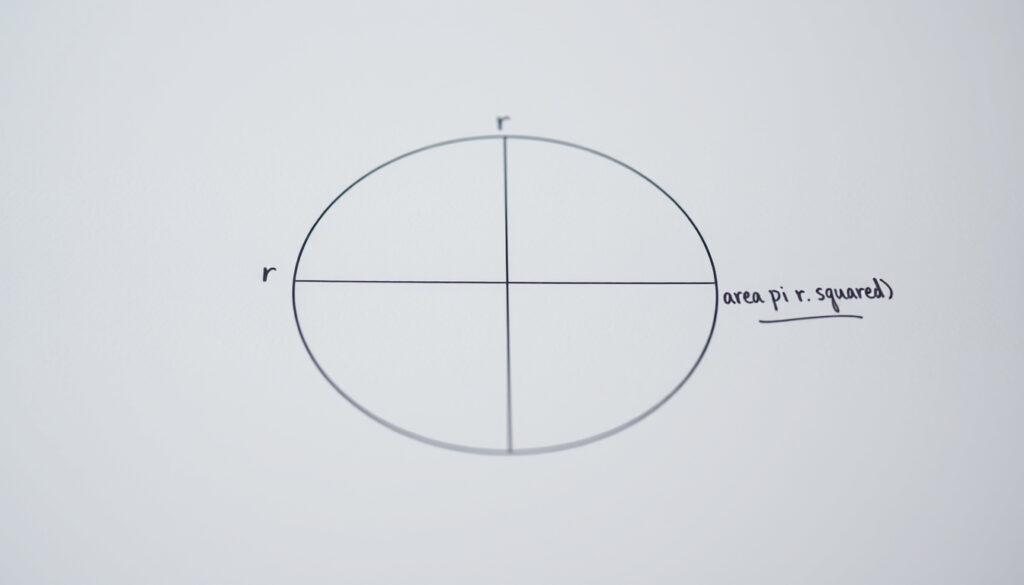
The area enclosed by a circle equals π multiplied by the radius squared. This formula, A = πr², appears everywhere from textbook problems to engineering calculations — yet its components are where students most often go wrong.
Standard formula A = πr²
- A = the area you want to find
- π (pi) = the constant approximately equal to 3.14159
- r² = radius multiplied by itself (NOT 2 × radius)
A common student mistake is confusing r² (radius squared) with 2r (two times the radius). These are fundamentally different operations, and mixing them up will give you the wrong answer every time, according to Math Antics on YouTube, an educational content creator specializing in foundational math concepts.
Squaring the radius is NOT the same as multiplying by 2. r² means r × r; 2r means r + r. This single error accounts for most wrong answers on circle problems.
Role of π (pi)
Pi represents the ratio of a circle’s circumference to its diameter — no matter how large or small the circle. This ratio always equals approximately 3.14159, a value that has fascinated mathematicians for millennia. Khan Academy, the nonprofit educational institution, explains that π is an irrational number — its decimal expansion goes on forever without repeating.
Units of measurement
Since area measures two-dimensional space, the answer always comes in square units: cm², m², square inches, or square kilometers. If you measure a circular garden in meters, its area goes in square meters (m²). The National Institute of Standards and Technology (NIST) provides standardized formulas for these conversions in official weights and measures applications.
How to work out area from diameter?
Sometimes you’ll know the diameter instead of the radius — and that’s fine, as long as you convert first. The formula handles this directly, but working through it step-by-step prevents the most common errors.
Convert diameter to radius
The relationship is straightforward: diameter equals twice the radius. So to find the radius, divide the diameter by 2. If your diameter is 12 feet, the radius is 6 feet — Math with Mr. J on YouTube, an educator providing free math tutorials, demonstrates this conversion in several worked examples.
Formula A = π(d/2)²
This version of the area formula uses diameter directly. You divide the diameter by 2 to get the radius, then square it and multiply by π. The math works out identically — it’s just written to handle a different starting measurement. The Omni Calculator site provides both formula versions with interactive examples.
Step-by-step example
- Start with a circle that has a 12-inch diameter
- Divide by 2: radius = 12 ÷ 2 = 6 inches
- Square the radius: 6² = 36
- Multiply by π: 36 × 3.14 = 113.04 square inches
Albert.io educational platform provides this exact example with additional variations showing how the method scales to different diameter measurements.
Engineers and architects often receive diameter measurements from field surveys. Converting between radius and diameter without remeasuring saves time and prevents costly errors in construction and manufacturing.
How to use 3.14 to find the area of a circle?
For quick estimates or hand calculations, using π ≈ 3.14 gives you a result that’s within 0.06% of the exact value. That’s precise enough for most classroom problems and many practical applications.
Approximating π as 3.14
The exact value of π is an irrational number (approximately 3.14159265), but for everyday use, rounding to 3.14 works well. Omni Calculator notes that 3.14 is accurate enough for problems where you don’t need more than two decimal places in your answer.
Example calculations
For a circle with 12 cm radius: 12² = 144, then 144 × 3.14 = 452.16 cm². Using the exact π value gives 452.39 cm² — a difference of less than 0.25 cm². Albert.io walks through this calculation with additional rounding guidance for different precision requirements.
When to use exact π
In scientific and engineering work where small differences compound (like calculating material volumes or orbital trajectories), using the exact π value or a more precise approximation (3.14159) matters more. The NIST uses 3.1416 in its official measurement standards — three additional decimal places over the common 3.14 approximation.
What is the formula 2πr?
The formula 2πr is not an area formula at all — it’s the circumference formula. Confusing these two is one of the most frequent mix-ups in geometry.
Distinguishing area from circumference
Circumference measures the outer boundary (the perimeter); area measures the space inside. For circumference, you multiply π by the diameter or by twice the radius. For area, you multiply π by the radius squared. Math Antics on YouTube emphasizes this distinction: “In the case of the circumference, you are multiplying Pi times the diameter, and in the case of area, you are multiplying Pi times the radius squared.”
C = 2πr or πd
Both formulas produce the same circumference result. If you know the radius, use C = 2πr. If you know the diameter, use C = πd. Study.com educational platform provides a detailed explanation of how these equivalent forms relate to each other through the diameter-radius connection (d = 2r).
Common mix-ups
- Area uses radius squared (r²), not diameter
- Circumference uses diameter directly (d) or doubled radius (2r)
- Area gives square units; circumference gives linear units
Tutors.com notes that the relationship between circumference and diameter is always the same ratio (π), which is why knowing one measurement helps you find the other.
The formula 2πr calculates circumference — how far around the circle is. A = πr² calculates area — how much space the circle fills. These are measuring two different things and should never be substituted for each other.
Is calculating area easier with radius or diameter?
The radius method is generally more direct, but the diameter method has practical advantages in certain situations. Here’s how to decide which approach fits your problem.
Pros of radius method
- Direct formula: A = πr² without any conversion step
- Fewer operations — just square and multiply
- Standard textbook approach, so examples usually give radius
Diameter method steps
- Divide diameter by 2 to get radius
- Square the result
- Multiply by π
The extra step of halving the diameter adds one calculation, but as Omni Calculator demonstrates, this becomes intuitive once you understand that the diameter-based formula A = π(d/2)² simplifies to the same thing — it’s just written to match how many problems are posed in real life.
Real-world choices
In manufacturing and construction, diameters are often easier to measure directly (across the widest point), making the A = π(d/2)² approach more practical. In academic problems, radii are more commonly given, favoring the A = πr² form. Albert.io educational platform notes that both methods are mathematically equivalent — the choice often depends on which measurement you start with.
Step-by-step calculation guide
Working through a complete example helps solidify the process. Here’s a detailed walkthrough from measurement to final answer.
- Identify your known measurement — Is it radius or diameter?
- If diameter: convert to radius — Divide by 2
- Square the radius — Multiply it by itself (r × r)
- Multiply by π — Use 3.14 for estimates, 3.14159 for precision
- Add units — Remember to square your linear units
Example: A circular table has a diameter of 80 cm. What’s its surface area?
- Radius = 80 ÷ 2 = 40 cm
- Radius² = 40² = 1,600 cm²
- Area = 1,600 × 3.14159 ≈ 5,026.55 cm²
The Omni Calculator tool allows you to input either radius or diameter and see both formula paths, which can help verify your hand calculations.
“r squared is NOT the same thing as 2 times r. That’s a common mistake that students make when first learning how to find the area of a circle.”
— Math Antics on YouTube (educational content creator)
“In a circle with radius r and diameter d, the circumference is C = πd and the area is A = πr². The relationship between these formulas reflects the fundamental geometry of circles.”
— Khan Academy (nonprofit educational institution)
For students mastering circle geometry, the takeaway is straightforward: memorize A = πr², convert diameter to radius before plugging in, and never confuse the area formula with the circumference formula 2πr. Practice with a few varied examples — radii, diameters, different units — and the process will become automatic.
Related reading: 65 Fahrenheit to Celsius Formula
After mastering A = πr² with radius or diameter, explore these step-by-step examples that apply the formula to real-world scenarios.
Frequently asked questions
What units are used for circle area?
Area always uses square units: cm², m², square inches, km², and so on. The exponent 2 in r² tells you to square both the number and the unit.
How accurate is using pi as 3.14?
Using 3.14 gives you an answer within 0.06% of the true value. For most classroom problems, this precision is more than enough — but for engineering or scientific work, use 3.14159 or more digits.
Can area be negative?
No. Area is a physical measurement of two-dimensional space. A negative area has no meaning in standard geometry — if your calculation produces a negative result, check for an arithmetic error.
What if the radius is in centimeters?
Then your answer will be in square centimeters (cm²). The units follow the calculation: if radius is in cm, radius² is in cm², and multiplying by π keeps cm² as your unit.
Is there a formula without pi?
Mathematically, pi is fundamental to circles — it defines the relationship between diameter and circumference. Some approximations use 22/7 (about 3.1429) as a fraction alternative, but pi itself cannot be eliminated from precise circle calculations.
How does area scale with radius?
Area scales with the square of the radius. If you double the radius, the area becomes four times larger (2² = 4). Triple the radius, and the area becomes nine times larger (3² = 9). This squared relationship is why circles cover more space than you might initially expect as they grow.
What is the exact value of pi?
Pi (π) is an irrational number — it cannot be expressed as a simple fraction and its decimal expansion continues infinitely without repeating. The most commonly used approximation is 3.14159, though supercomputers have calculated trillions of digits.
What’s the difference between area and perimeter?
Area measures the space inside a shape (in square units); perimeter measures the length around the edge (in linear units). For a circle, perimeter is called circumference and uses the formula C = πd or C = 2πr.
More related posts
 Riley Gaines: Biography, Husband, Net Worth, and Key Events
 Brie Bella: Biography, Children, Husband, and Why She Left WWE
 Cast of All Her Fault: Full Actors & Characters List
 Lacey Chabert: Biography, Hallmark Movies, Husband & More
 Tom Felton: Wife, Relationship, Health, and Memoir Facts
 Redmi 8 to Buy – Prices, Availability and Specs in India
 Barberian’s Steak House Menu: Toronto Prices & Items
 Millennial Generation Age Range and Key Facts 2026