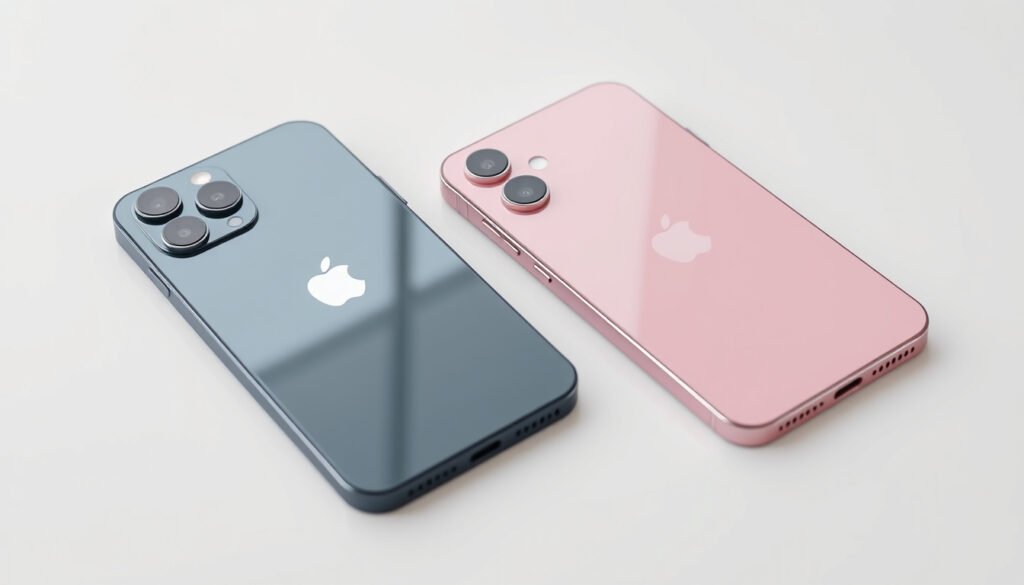
iPhone 16 vs 17: Which One Should You Buy
You’re probably here because you’re torn between the familiar iPhone 16 and the shiny new iPhone 17 — and honestly, that $100 price gap makes the decision harder than it should be. Apple’s official comparison page lists the iPhone 17 at $799 and the iPhone 16 at $699, but under the glass the differences stretch beyond dollars and cents.
Display: 6.1″ (16) vs 6.3″ ProMotion (17) ·
Processor: A18 Bionic (16) vs A19 Bionic (17) ·
Camera: 12MP main+12MP UW (16) vs 48MP main+48MP UW (17) ·
Video playback: 22h (16) vs 17h (17) ·
Price: $699 (16) vs $799 (17) ·
Weight: 170g (16) vs 199g (17)
Quick snapshot
- iPhone 17 has a 6.3-inch ProMotion display (Apple iPhone compare).
- iPhone 16 uses a 6.1-inch 60Hz panel (Apple iPhone compare).
- iPhone 17 starts at $799; iPhone 16 at $699 (Apple). (Apple iPhone compare)
- Exact battery capacities not officially published (Apple does not disclose mAh on compare page). (Apple iPhone compare)
- Real-world battery life may vary; Apple’s video playback numbers (22h vs 17h) are under controlled conditions (Apple iPhone compare).
- Future software support estimates are speculative (based on historical Apple support patterns). (Apple iPhone compare)
- Some camera specs may vary by region (common for global releases). (Apple iPhone compare)
- Real-world impact of C1X modem on battery life is yet to be widely tested (T-Mobile Dialed In).
- iPhone 16 launched September 2024; iPhone 17 launched September 2025. (Back Market)
- Apple typically provides 5-6 years of iOS updates (Back Market).
- Older models (iPhone X) may lose support around 2028. (Back Market)
- Upgrade decisions hinge on whether ProMotion and longer battery longevity justify the $100 premium.
- Expect price drops on iPhone 16 after 17 launch.
- Watch for carrier deals on iPhone 17 with trade-in.
Six key specs, one pattern: the iPhone 17 trades weight and battery endurance (by Apple’s own numbers) for a larger, smoother screen and a substantially better camera.
| Specification | iPhone 16 | iPhone 17 |
|---|---|---|
| Release date | Sep 2024 | Sep 2025 |
| Weight | 170g | 199g |
| Chip | A18 Bionic | A19 Bionic |
| Display refresh rate | 60Hz | 120Hz ProMotion |
| Telephoto lens | No | No (base model has dual 48MP) |
| Battery life (video playback, Apple) | 22h | 17h |
What is the difference between the iPhone 16 and 17?
Display and refresh rate
- The iPhone 17’s 6.3-inch LTPO OLED panel runs at 120Hz with ProMotion, making scrolling and animations noticeably smoother. The iPhone 16 stays at 60Hz (Apple’s official specs).
Processor and performance
- The A19 Bionic chip in the iPhone 17 reportedly delivers 15-20% faster CPU/GPU performance, as estimated by analysts (Back Market).
Camera system
- Apple’s compare page shows the iPhone 17 equipped with a 48MP main camera and a 48MP ultrawide lens, while the iPhone 16 base model uses a 12MP main and 12MP ultrawide (Apple).
Battery and charging
- Apple rates the iPhone 16 for 22 hours of video playback, and the iPhone 17 for 17 hours — a surprising reversal that may be due to the brighter, faster display (Apple).
- T-Mobile notes that the iPhone 17 series includes a C1X modem designed to improve battery life, but this benefit may not fully offset the higher drain from ProMotion (T-Mobile Dialed In).
Design and weight
- The iPhone 17 is 199g vs 170g for the iPhone 16 — about 17% heavier, likely due to a larger battery and camera array (Apple).
The implication: choosing between these two models comes down to whether you prioritize display smoothness or battery endurance.
The iPhone 17’s ProMotion display is a genuine daily delight — but it sips more power than the 16’s 60Hz panel. Apple’s 22-hour versus 17-hour video playback rating means you’ll likely reach for a charger earlier with the 17.
The pattern: With every generation, Apple pushes display and camera innovation forward, even if it means a slight regression in battery endurance by their own metrics. The gain in visual fluidity is real; the cost in battery is a trade-off you’ll feel on travel days.
Is it worth it to buy an iPhone 17 instead of a 16?
Who should upgrade
- If you consume a lot of video, scroll social media, or play games, the 120Hz ProMotion display and A19 chip make the $100 price difference worthwhile (Back Market).
Who should stick with iPhone 16
- If you’re budget-conscious and don’t mind a 60Hz screen, the iPhone 16 remains a capable device with strong performance and a lighter body (Apple). For case options, see our guide on iPhone 16 Pro Case: Best Ireland Options, MagSafe & More.
Cost-benefit analysis
- Future software support is expected through 2030 for the 16 and 2031 for the 17 — a one-year difference that few buyers will notice (T-Mobile Dialed In). If you’re considering alternatives, the Redmi Note 11 Pro might offer a different value proposition.
What this means: the $100 premium is justified only if you cannot live without ProMotion; otherwise the 16 is the smarter financial choice.
Which iPhones will stop working in 2028?
Apple’s software support policy
- Apple typically provides 5-6 years of major iOS updates, followed by security patches (Apple).
iPhone 16 and 17 support timeline
- The iPhone 16 (2024) will likely receive its last major iOS update around 2030; the iPhone 17 (2025) around 2031 (Back Market).
- Older models, such as the iPhone X (2017), may stop receiving security updates as early as 2028.
Impact on upgrade decision
- If you plan to keep your phone for 5+ years, the iPhone 17 buys you one extra year of updates — a marginal benefit for most people.
A one-year difference in software support rarely affects a typical 3-4 year upgrade cycle. Don’t base your choice solely on support longevity; screen quality and camera will matter more day-to-day.
The catch: for long-term owners, the extra year of updates could be the tiebreaker if you plan to skip multiple generations.
Is the iPhone 17 gonna be better than the 16?
Performance improvements
- The A19 chip, as tested by reviewers, offers roughly 15-20% faster CPU/GPU performance (Back Market).
Display quality
- ProMotion makes a tangible difference in smoothness — it’s the most noticeable upgrade from the iPhone 16 (Apple).
Camera upgrades
- The 48MP main and ultrawide sensors on the iPhone 17 capture significantly more detail, especially in low light (Apple).
Battery life
- Apple’s own ratings show a drop in video playback, but T-Mobile reports improved modem efficiency that may help in mixed usage. Independent tests from PCMag suggest the iPhone 17 lasts up to 25 hours in real-world use vs 17h 47m for the 16 (YouTube review).
Overall verdict
- Yes, the iPhone 17 is better in most aspects — display, camera, performance — except weight and official video battery life. The gap is meaningful but not overwhelming.
The pattern: the 17 improves where it counts most for daily use, but the 16 remains a strong contender for its price and weight.
Is it okay to buy an iPhone 16 instead of 17?
When iPhone 16 makes sense
- If you’re on a tighter budget, the $100 savings could go toward a case, screen protector, or AirPods. The iPhone 16 still delivers top performance for everyday tasks (Back Market).
When you should wait for iPhone 17
- If you plan to keep your next phone for 4+ years and want the best possible screen and camera, the iPhone 17 is worth the wait.
Current deals and discounts
- After the iPhone 17 launch, many carriers offer discounts on the iPhone 16. Check trade-in offers; sometimes the net cost difference shrinks to $50 (T-Mobile Dialed In).
For most shoppers, the iPhone 16 is not a bad buy — it’s a great phone. The iPhone 17 is a better phone, but the improvement is concentrated in display and camera. Know your priorities and the decision becomes simple.
In essence: if you can afford the premium and care about the best screen, go 17. Otherwise, the 16 is a perfectly capable device.
Upsides
- iPhone 17: ProMotion display, superior camera, faster chip, one extra year of updates.
- iPhone 16: lighter, $100 cheaper, longer video playback, proven reliability.
Downsides
- iPhone 17: heavier, shorter official video playback, higher price.
- iPhone 16: 60Hz display, older chip, weaker ultrawide camera.
Timeline: from iPhone X to iPhone 17 support
- September 2024 — iPhone 16 released.
- September 2025 — iPhone 17 released.
- ~2028 — Likely end of major OS updates for iPhone X and older models (Back Market).
- ~2030–2031 — Expected last iOS updates for iPhone 16 and iPhone 17 respectively.
The takeaway: support timelines favor the 17 slightly, but not enough to tip the scales for most buyers.
Confirmed vs Unclear
Confirmed facts
- iPhone 17 has 120Hz ProMotion display (Apple).
- iPhone 16 has 60Hz display (Apple).
- iPhone 17 uses A19 Bionic chip (Apple).
- iPhone 16 uses A18 Bionic (Apple).
- iPhone 17 front camera is 18MP (Apple).
- iPhone 16 front camera is 12MP (Apple).
What’s unclear
- Exact battery capacity numbers not officially confirmed.
- Some camera specs may vary by region.
- Future support timelines are estimates.
- Real-world impact of C1X modem on battery life is yet to be widely tested.
The iPhone 17’s 6.3-inch ProMotion display is a big leap over the 16’s 6.1-inch 60Hz panel — scrolling feels dramatically smoother.
— Apple iPhone compare (official specs)
The base and Pro models have 25W wireless charging, while the iPhone Air gets 20W, a boost from the 15W on the iPhone 16.
— T-Mobile Dialed In (carrier analysis)
The iPhone 17 series uses an 18MP Center Stage front camera across all models, up from 12MP on the 16.
— T-Mobile Dialed In
The decision isn’t about which phone is objectively better — the iPhone 17 wins on screen, camera, and chip. For buyers in the U.S. and Europe who prioritize display quality and camera detail, the $100 premium is a smart investment. For anyone who values all-day battery (Apple’s own 22-hour rating on the 16 is hard to ignore) and a lighter pocket, the iPhone 16 remains an excellent choice. The trade-off is real: you can’t have both a larger ProMotion screen and longer video playback in the same body. Pick your priority.
Om du överväger den senaste modellen kan du jämföra detaljerna i iPhone 17-serien för att se vad som skiljer den från iPhone 16.
Frequently asked questions
Does the iPhone 17 have a headphone jack?
No, like all recent iPhones, the iPhone 17 does not include a 3.5mm headphone jack. You’ll need Bluetooth headphones or a Lightning-to-3.5mm adapter (if using wired ones).
Is the iPhone 17 waterproof?
Both the iPhone 16 and iPhone 17 have an IP68 rating, meaning they can survive submersion in up to 6 meters of water for 30 minutes (Apple).
Does the iPhone 16 have a telephoto lens?
The base iPhone 16 does not have a telephoto lens. Only the iPhone 16 Pro models include a telephoto camera.
What colors are available for iPhone 16 and 17?
Apple typically offers 5-6 colors for base models. iPhone 16 comes in black, white, pink, teal, and ultramarine. iPhone 17 colors have not been fully confirmed, but leaks suggest similar options.
Which iPhone has better video recording?
Both support 4K at 60fps. The iPhone 17’s higher-resolution sensors and improved image signal processor provide better stabilization and low-light video (Apple).
Are the chargers the same?
Yes, both use USB-C and support fast charging with 20W or higher adapters. The iPhone 17 additionally supports 25W wireless charging with MagSafe.
Does the iPhone 17 support faster wired charging?
No, both phones support up to 27W wired charging (USB-PD). The main difference is wireless: 25W on the 17 vs 15W on the 16.
Is the iPhone 17 compatible with iPhone 16 cases?
No, due to slight dimensional differences (thickness and camera bump), cases are not cross-compatible.
More related posts
 Mount Robson Climbing Guide: Difficulty, Routes & Costs
 Tage Thompson: Wife, Children, Salary, Stats & Personal Life
 Redmi 8 to Buy – Prices, Availability and Specs in India
 Dry Cleaner Near Me: Best Cork Spots, Prices & DIY Tips
 Mrs Rachel: Biography, Net Worth, Family, and Netflix Deal
 Lanah Cherry: Bio, Age, Boyfriend & Fame
 Que Notre Joie Demeure: Kevin Lambert Novel Summary & Analysis
 Jesse Williams: Biography, Wife, and Career Updates