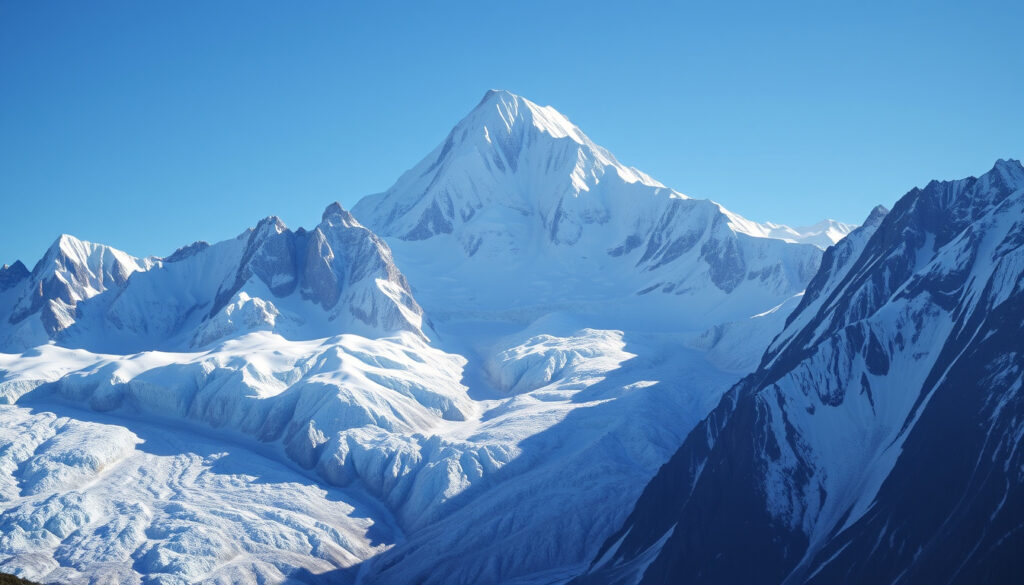
Mount Logan: Canada’s Highest Peak and Climbing Guide
Most climbers who dream of North America’s biggest peaks automatically think of Denali. But there’s a mountain in Canada’s Yukon that rivals it in challenge and remoteness — Mount Logan.
Elevation: 5,959 m (19,551 ft) · Location: Yukon, Canada – St. Elias Mountains · Rank: Highest in Canada, 2nd in North America · First Ascent: 1925 · Prominence: 5,250 m (17,221 ft)
Quick snapshot
- Highest peak in Canada (BlackSheep Adventure)
- Located in St. Elias Mountains, Yukon (BlackSheep Adventure)
- Elevation 5,959 m / 19,551 ft (BlackSheep Adventure)
- Exact death rate – estimates range 1–2% (Mountain Madness)
- Total number of summits – likely over 500 but no official registry (Mountain Project)
- Shortest expedition duration – highly weather-dependent (International Mountain Guides)
- 1925 – First ascent by A.H. MacCarthy team (Wikipedia)
- 2005 – First winter ascent (Wikipedia)
- 2015 – Record year: 18 climbers reached summit (International Mountain Guides)
- Growing number of guided trips via ski planes (Mountain Madness)
- Climate change may alter glacier access and crevasse patterns (International Mountain Guides)
| Attribute | Value | Source |
|---|---|---|
| Elevation | 5,959 m (19,551 ft) | BlackSheep Adventure |
| Location | Yukon, Canada – St. Elias Mountains | BlackSheep Adventure |
| Prominence | 5,250 m (17,221 ft) | Wikipedia |
| First Ascent | 1925 by A.H. MacCarthy et al. | Wikipedia |
| Death Rate | Estimated 1–2% (similar to Denali) | Mountain Madness |
| Most Common Route | King’s Trench | BlackSheep Adventure |
| Typical Expedition Duration | 14–21 days | Mountain Madness |
| Skill Level | Intermediate – requires glacier and cold‑weather experience | International Mountain Guides |
The pattern: this table condenses the key specs every climber needs before planning.
Where is Mount Logan located?
What mountain range is Mount Logan in?
Mount Logan rises in the St. Elias Mountains of the Yukon Territory, Canada, within Kluane National Park near the Alaska border. The range spans a vast wilderness of glaciers and peaks, creating one of the most remote alpine environments on the continent (BlackSheep Adventure).
How tall is Mount Logan?
The summit reaches 5,959 m (19,551 ft) according to most authoritative sources, though some lists round to 5,957 m or 19,545 ft — a minor variance typical of large glaciated peaks (Mountain Project). That makes it the highest mountain in Canada and the second highest in North America after Denali.
Mount Logan’s location in the remote St. Elias Mountains is the single biggest factor driving expedition difficulty — getting there costs days of bush‑plane logistics, not just hours on a highway.
Mount Logan’s position inside Kluane National Park means climbers need permits and must coordinate with Parks Canada. Access is typically by ski‑plane from Kluane Lake to a base camp on the Logan Glacier, landing on the ice at roughly 2,300 m (Mountain Madness).
The implication: Mount Logan’s isolation means help is days away — a reality that separates it from more accessible climbs like Mount Rainier or even Denali’s West Buttress.
What is special about Mount Logan?
What makes Mount Logan unique among North American peaks?
Mount Logan has the largest base circumference of any non‑volcanic mountain on Earth — its massif spans roughly 100 km end to end. That immense bulk, combined with a prominence of 17,221 ft, ranks it among the world’s most topographically prominent peaks (Wikipedia).
The mountain is still tectonically rising as the Pacific Plate pushes under the North American Plate, and its summit icecap feeds dozens of outlet glaciers that snake into the surrounding valleys (Mountain Project).
Because of its extreme remoteness, Mount Logan sees only a few dozen climbers per year — a fraction of the thousands who attempt Denali. For those who make it, the reward is a true wilderness experience, with no rescue infrastructure, no fixed lines, and often days without seeing another rope team.
The trade-off: that same solitude makes logistics far heavier and safety margins thinner than on more popular peaks.
Is Mount Logan harder than Denali?
How do the climbs compare in terms of difficulty?
Denali’s higher altitude (6,190 m / 20,310 ft) means thinner air and a greater risk of acute mountain sickness. But Mount Logan’s challenges come from a different direction: extreme weather, isolation, and logistical complexity. Mountain Madness describes Logan as “a notch above Denali in seriousness” because of its remoteness and the self‑reliance it demands (Mountain Madness).
International Mountain Guides notes that while the King’s Trench route may have no highly technical climbing, expedition members must have previous glacier experience and be skilled in crevasse rescue, cramponing, and cold‑weather camping (International Mountain Guides).
Denali has a semi‑permanent ranger patrol, dozens of climbers at each camp, and frequent plane traffic. Logan has none of that — you are truly on your own.
What are the main challenges on Mount Logan vs Denali?
The table below draws a direct contrast that explains why the two peaks test different skills.
| Factor | Mount Logan | Denali |
|---|---|---|
| Summit elevation | 5,959 m (19,551 ft) | 6,190 m (20,310 ft) |
| Expedition duration | 14–21 days | 17–24 days |
| Typical approach | Ski‑plane from Kluane Lake, land on glacier | Fly to base camp at 2,200 m (Kahiltna Glacier) |
| Ranger presence | None – no fixed patrols | Seasonal NPS rangers on the mountain |
| Rescue infrastructure | Minimal – rely on party self‑rescue | NPS rescue teams, helicopter capability |
| Climber density | Few dozen per year | ~1,200 per year |
The pattern: Denali tests your altitude tolerance; Logan tests your self‑sufficiency. For experienced expedition climbers, Logan’s solitude is a draw; for those used to Denali’s support network, it can be a shock.
How long does it take to hike Mount Logan?
What is the typical expedition duration?
A guided ascent of the King’s Trench route usually takes 14 to 21 days, day by day depending on weather windows and team speed (Mountain Madness). The standard schedule includes several days for approach, cache‑carrying, acclimatization, and a long summit day that can last 12 hours or more.
What are the stages of a Mount Logan climb?
- Fly in: Ski‑plane from Kluane Lake lands on the Logan Glacier at ~2,300 m. (Mountain Madness)
- Establish base camp: Set up camp and organize loads – sleds weigh 50–60 lbs per person.
- Acclimatize and cache: Move gear up the glacier over 4–5 days, caching supplies at higher camps.
- Summit push: Climb the King’s Trench to the plateau, then traverse nearly 4 miles between 17,600 ft and the true summit. (Mountain Madness)
- Descend and fly out: Retreat to base camp and wait for a weather window for the ski‑plane pickup.
The trade-off: weather delays can easily add a week. Many expeditions budget an extra 5–7 days as buffer.
Has anyone ever summited Mount Logan?
Who made the first ascent?
The first ascent was achieved in 1925 by a Canadian‑American party led by A.H. MacCarthy. The team spent two months on the mountain and used a combination of skis, sleds, and fixed ropes to reach the top via the King’s Trench (Wikipedia).
How many people have summited?
As of recent counts, roughly 500–600 climbers have reached the summit, with a record year in 2015 that saw 18 successful ascents (International Mountain Guides). That number is tiny compared to Denali’s annual tally of over a thousand. The first winter ascent came much later, in 2005, by a Canadian team.
The implication: summiting Mount Logan remains a genuine achievement even for experienced alpinists — the stats show it’s far from routine.
“Mount Logan is an intermediate‑level expedition climb, but the remoteness and overall challenge make it a notch above Denali in seriousness.”
Mountain Madness (guided expedition provider)
“The Mount Logan climb is not considered highly technical in a mountaineering sense, but expedition members must have previous glacier experience and be familiar with crevasse rescue.”
International Mountain Guides (leading mountain guiding company)
Confirmed facts
- Elevation of 5,959 m (multiple sources consistent within 2 m)
- Location in St. Elias Mountains, Yukon
- First ascent in 1925
- Highest mountain in Canada
- King’s Trench is the standard route
What’s unclear
- Exact death rate (estimates vary from 1% to 2%)
- Total number of successful summits (likely over 500 but no official registry)
- Shortest possible expedition duration (weather‑dependent)
For climbers weighing whether to target Mount Logan, the decision hinges on one variable: how comfortable you are with solitude and self‑reliance. If you’ve cut your teeth on Denali or in the Alps and you’re ready for an objective where no one is coming to get you, Logan rewards with an experience few have had. If you prefer support infrastructure and a social camp scene, stick with Denali. The choice is clear: Logan demands more of you as an individual, and that’s exactly why its summit feels like a true frontier.
explore-share.com, publications.americanalpineclub.org, countryhighpoints.com
Frequently asked questions
Is Mount Logan visible from the coast?
Mount Logan is not directly visible from the coast — it lies about 100 km inland, hidden behind the St. Elias coastal ranges. On clear days, its bulk can sometimes be seen from the Alaska Highway near Haines Junction, Yukon.
What is the best time to climb Mount Logan?
The typical climbing season is May through July, when daylight is long and temperatures are comparatively moderate. Late April and August are possible but weather windows narrow significantly.
Can a beginner climb Mount Logan?
No — this is an intermediate to advanced expedition climb. Mountaineering experience with glacier travel, crevasse rescue, and cold‑weather camping is mandatory. Guides require prior multi‑day expeditions on similar terrain.
What gear is needed for a Mount Logan expedition?
Climbers need a full mountaineering kit: four‑season tent, sleeping bag rated to -40°C, ice axe, crampons, harness, crevasse rescue gear, skis or splitboard, sled, and mountain boots. Guides provide a detailed packing list.
How dangerous is Mount Logan?
Mount Logan’s dangers are similar to those of other large glaciated peaks: crevasses, avalanches, severe cold, and storms. Its isolation elevates the risk because rescue infrastructure is minimal. The death rate is estimated at 1–2%.
What is the cost of a Mount Logan expedition?
Guided trips range from $12,000 to $18,000 per person, including guide fees, ski‑plane transport, food, and group gear. Independent expeditions are cheaper but require the same investment in logistics and equipment.
Are there guided trips for Mount Logan?
Yes – several reputable outfitters offer guided climbs, including Mountain Madness, International Mountain Guides, and BlackSheep Adventure. These typically handle all logistics and provide experienced guides for 3‑week expeditions.
More related posts
 Happy New Year 2026 GIFs – Free Sources and Sharing Guide
 Power Book III: Raising Kanan Episodes – Guide & Season 5 News
 GTA SA: Complete Guide to Grand Theft Auto: San Andreas
 Jesse Plemons: Biography, Weight Loss, Wife, and Movies
 Natasha Romanoff: Age, Death, Sexualization & Weakest Avenger
 1 lb to Grams: The Exact Conversion and Practical Uses
 The Secret Lives of Mormon Wives: Seasons, Cast & Scandal Explained
 Grown Ups (2010) – Stream, Ratings, and Grown Ups 3 Update