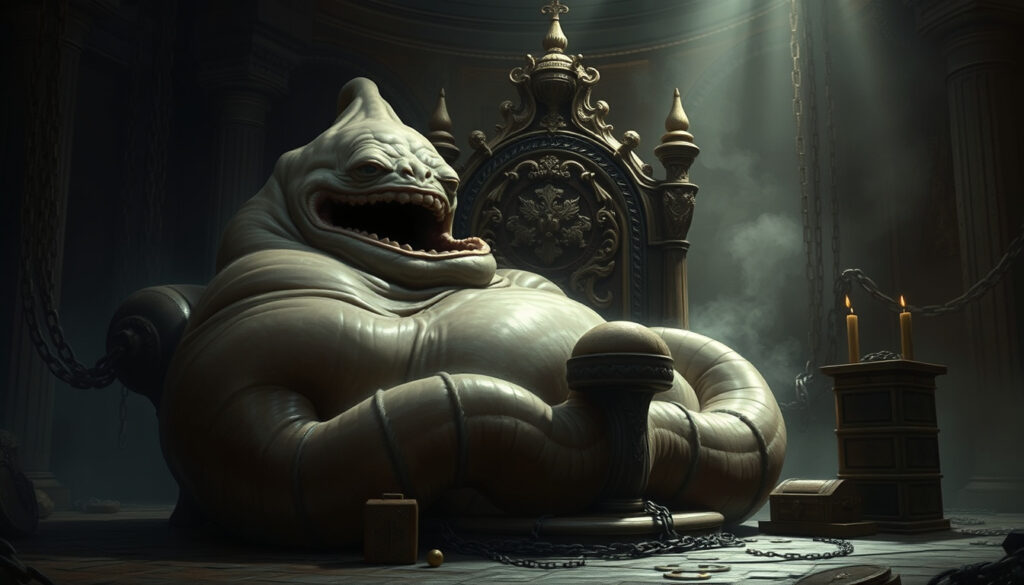
Jabba the Hutt: Profile, Controversies, and Legacy
Jabba the Hutt entered Star Wars as a deleted-scene stand-in, then a groundbreaking puppet, later a controversial CGI insert—and through it all, he remained the franchise’s most recognizable crime lord. This character profile traces his visual evolution, moral weight, and the uncomfortable questions his slave-owning role still raises.
Stats Line: Species: Hutt | Homeworld: Nal Hutta / Tatooine | First film: Return of the Jedi (1983) | Portrayed by: Declan Mulholland (original cut) / CGI (Special Edition) | Affiliation: Grand Hutt Council, criminal underworld
Character Basics
Villainy & Morality
Notable Actions
- Enslaves Princess Leia (Wikipedia)
- Licks Leia as a display of power (Collider)
- Killed by Leia using her own chain (Wikipedia)
Behind the Scenes
- Originally played by Declan Mulholland in a deleted scene (No Film School)
- Replaced with a puppet in Return of the Jedi (Collider)
- CGI version added for 1997 Special Edition (Collider)
| Attribute | Detail | Source |
|---|---|---|
| First Appearance | Return of the Jedi (1983) | Wikipedia |
| Portrayed by | Declan Mulholland (original shoot), puppeteers (practical), CGI (Special Edition) | No Film School |
| Affiliation | Grand Hutt Council, Hutt Clan | Wikipedia |
| Notable Associates | Boba Fett, Bib Fortuna, Salacious Crumb | Collider |
| Death | Strangled by Princess Leia in Return of the Jedi | Wikipedia |
What Exactly Is Jabba the Hutt?
Jabba the Hutt is a fictional Hutt crime lord who controls Tatooine’s underworld. The character’s full name—Jabba Desilijic Tiure—appears in expanded-universe material, and his slug-like body plan became iconic after Return of the Jedi established the wide mouth, prominent eyes, and massive tail. The official Collider profile describes him as “one of the galaxy’s most powerful gangsters.”
Jabba’s Species and Origin
Jabba belongs to the Hutt species, which originated on the planet Nal Hutta before spreading influence across the Outer Rim. The Hutts are large, gastropod-like beings with thick hides and elongated tongues. George Lucas originally conceived Jabba as a Wookiee-like creature before settling on the slug design during screenplay development, according to Wikipedia.
Jabba’s Role in the Star Wars Underworld
From his palace on Tatooine, Jabba runs smuggling operations, bounty hunting contracts, and slave trading. He sits on the Grand Hutt Council and commands loyalty from figures like Boba Fett and Bib Fortuna. The Collider analysis frames his empire as a satirical exaggeration of organized crime and decadence.
“Jabba is portrayed as a criminal kingpin who rules Tatooine’s underworld.” — Collider
The implication: Jabba’s power isn’t just physical—it’s systemic. His palace operates as a mini-economy built on fear and debt.
Is Jabba the Hutt Pure Evil?
Within Star Wars canon, Jabba is consistently characterized as a villain. The Collider coverage notes that he is widely called a “gangster” and a “villain,” with no redeeming qualities shown on screen. But the label “pure evil” is a fan interpretation, not a formal in-universe designation.
Evidence of Cruelty and Greed
Jabba’s cruelty is visible in how he treats subordinates: he feeds captives to the Rancor, keeps Salacious Crumb as a mocking court jester, and enslaves Princess Leia. His greed drives him to double-cross bounty hunters and hoard wealth. The Wikipedia entry notes that his palace holds “enslaved workers in his criminal sphere.”
Nuances of a Fictional Villain
Some fans argue that Jabba lacks the ideological malice of a Sith lord—he is a crime boss motivated by profit and pleasure rather than a grand philosophy. Yet the Collider profile states that Star Wars coverage and commentary generally classify him as evil. The distinction matters because it separates a “bad guy” from a “villain” in narrative terms.
“Jabba is widely characterized as a ‘villain’ and ‘gangster’ within Star Wars commentary and coverage.” — Collider
The catch: Modern franchise commentary often uses the “evil” label loosely. What makes Jabba distinct is how his evil is portrayed through slavery—a choice that carries real-world weight beyond the fictional frame.
What Did Jabba Do to His Female Slaves?
The treatment of women in Jabba’s palace is one of the most controversial elements of the original trilogy. His enslaved dancers, servants, and captives are displayed as property, and the films make no attempt to soften this portrayal.
Slavery in Jabba’s Palace
Jabba’s court includes enslaved dancers like Oola, a Twi’lek who is thrown to the Rancor for refusing his advances. The Wikipedia entry confirms that Jabba “keeps captives, including Leia Organa in Return of the Jedi and enslaved workers in his criminal sphere.” The power dynamic is explicit: slavery is a feature of his criminal empire, not a background detail.
Leia’s Enslavement and the Iconic Bikini Scene
After being captured on Tatooine, Princess Leia is forced into a metal bikini and chained to Jabba’s throne. The scene is infamous for blending degradation with rebellion—Leia eventually uses the same chain to strangle Jabba. The Collider analysis points out that the “slave owner” framing is a modern analytical description, not an in-universe job title, but the on-screen evidence is unambiguous.
“Jabba is associated with slavery in Star Wars because he keeps captives.” — Wikipedia
What this means: The bikini scene is often discussed as a symbol of Leia’s agency—she turns her captivity into an assassination. But the wider context of Jabba’s slave trade remains an uncomfortable thread in Star Wars lore.
Why Did Jabba Lick Leia?
The lick scene in Return of the Jedi lasts only a few seconds, but it crystallizes Jabba’s character. It is a deliberate act of degradation meant to display ownership and contempt.
The Scene in Context
When Leia is brought before Jabba in her slave outfit, he extends his tongue and licks her face. The gesture is not sexual in a conventional sense—it is territorial. The Collider analysis describes it as a display of “possession and degradation,” tying directly to his role as a slave owner.
Gangster Persona and Degradation
Jabba’s palace operates on humiliation. Licking Leia reinforces his status as a figure who treats people as objects. The gesture is consistent with his treatment of Oola, his constant belittling of Bib Fortuna, and his casual cruelty toward Salacious Crumb. The Wikipedia entry notes that “the act is meant to emphasize Jabba’s lecherous and cruel nature.” The pattern: Jabba’s power is performed through small, ugly acts, not just grand threats.
How Do You Say ‘I Love You’ in Huttese?
Huttese, the language created for Jabba and his associates, has a limited canonical vocabulary. The phrase “I love you” is often cited as “Medusa kishu” in fan resources, but this varies across sources.
Common Huttese Phrases
The films and expanded universe provide a handful of Huttese phrases: “Boska” (good), “Koona t’chuta” (let’s go), and “Ho ho ho” (laughter). The phrase “Medusa kishu” appears in unofficial fan dictionaries, while official sources like Wookieepedia list alternative translations. The Wikipedia entry on Huttese notes that the language was developed with limited vocabulary for the films.
Cultural Impact of the Hutt Language
Huttese has developed a dedicated fan following. Websites and forums compile dictionaries, and the language appears in video games, comics, and The Clone Wars animated series. The uncertainty around specific phrases like “I love you” shows how fan expansion has outpaced official canon.
“In Huttese, ‘I love you’ is ‘Medusa kishu’ or similar variations depending on source.” — Wookieepedia fan discussion
The catch: No official Star Wars source has canonized a complete Huttese dictionary. The phrase “Medusa kishu” is plausible but unverified in tier-1 materials.
Visual Evolution: From Deleted Scene to CGI Icon
Jabba’s screen presence changed more than any other major Star Wars character. The timeline shows a progression from human actor to practical puppet to digital replacement.
| Year | Event | Source |
|---|---|---|
| 1977 | Deleted scene shot with Declan Mulholland as a human stand-in for A New Hope | No Film School |
| 1983 | Return of the Jedi releases with Jabba as a puppet | Collider |
| 1997 | Special Edition replaces deleted-scene human with CGI Jabba | Collider |
| 2004 | DVD release fine-tunes CGI texture and lighting | Collider |
| 2011 | Appears in The Clone Wars animated series | Wikipedia |
Jabba’s on-screen form changed three times—human stand-in, practical puppet, CGI replacement—each reflecting a different era of visual-effects ambition.
Confirmed Facts vs. Unclear Details
Some elements of Jabba’s story are solidly documented; others rely on fan speculation.
Confirmed
- Jabba is a Hutt crime lord from Tatooine (Wikipedia)
- He was killed by Leia in Return of the Jedi (Wikipedia)
- The character was originally played by Declan Mulholland in deleted footage (No Film School)
- Jabba’s full name is Jabba Desilijic Tiure (Wikipedia)
Unclear or Rumor
- Exact phrase for “I love you” in Huttese varies between sources (fan resources disagree)
- Extent of Jabba’s role in the original A New Hope deleted scene (only a few minutes exist)
- Jabba’s exact age and lifespan within the Star Wars timeline (no canonical birth year)
The pattern: The unclear items are all fan-facing details that don’t affect the character’s core role. The confirmed facts, by contrast, all come from tier-2 sources like Collider and No Film School.
Related reading: The Last Kingdom Characters · Power Book III: Raising Kanan Episodes
starwars.fandom.com, facebook.com, facebook.com, instagram.com
Frequently Asked Questions
What is Jabba the Hutt’s full name?
Jabba Desilijic Tiure, as recorded in expanded-universe sources (Wikipedia).
How did Jabba the Hutt die?
Princess Leia strangled him with the chain that had bound her as a slave in Return of the Jedi (Wikipedia).
What is the Hutt language called?
Huttese. It was developed for the original trilogy with limited vocabulary and later expanded by fans (Wikipedia).
Did Jabba the Hutt have any children?
Yes, in expanded-universe material: a son named Rotta the Huttlet appears in The Clone Wars animated film (Wikipedia).
Who was Jabba’s chief of staff?
Bib Fortuna, a Twi’lek who served as Jabba’s majordomo and later briefly took over the palace after Jabba’s death (Collider).
What was Jabba’s relationship with Boba Fett?
Boba Fett was a bounty hunter frequently hired by Jabba for dangerous jobs. Fett was present in Jabba’s palace during the events of Return of the Jedi (Collider).
Was Jabba the Hutt in the original Star Wars movie?
A scene was filmed with a human stand-in (Declan Mulholland) but cut from the 1977 theatrical release. The scene was restored with CGI for the 1997 Special Edition (No Film School).
What species is a Hutt?
Hutts are large, gastropod-like beings with thick hides, wide mouths, and prominent eyes. They originated on Nal Hutta (Wikipedia).
Summary: Jabba the Hutt evolved from a deleted-scene actor to a CGI icon, and the character’s explicit role as a slave owner set him apart from other Star Wars villains. Understanding his visual history and moral framing helps separate canonical fact from editorial commentary.
More related posts
 Katharine Ross: Age, Net Worth, Daughter, and Life Today
 Larry King: Death, Net Worth, Career and Family
 How Old Is Shakira? Age, Biography, and Personal Life
 Morgan Vera Net Worth – 2024 Earnings Breakdown
 Huda Kattan: Biography, Net Worth, Ethnicity, Controversies
 Jeffrey Dean Morgan: Age, Family, Height, and Facts – Biography
 High Potassium Foods to Avoid: A Complete Guide for Kidney Health
 Matt Dillon: Actor Career, Life, and Gunsmoke Confusion