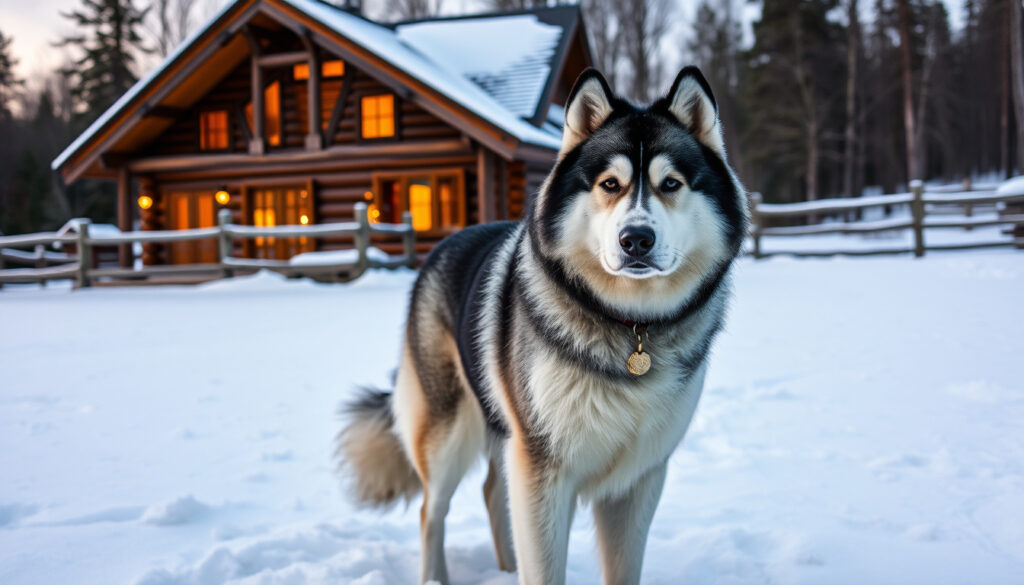
Alaskan Malamute: Temperament, Size, and Family Suitability
That wolf-like face and thick white coat hide a freight-hauler’s independence: the Alaskan Malamute is an 85-pound working breed that doesn’t bend to its owner’s will. Before you commit to a Mahlemut descendant, this guide lines up the breed’s real temperament, its size compared to a Husky, and what family suitability means when “affectionate” comes with “strong-willed.”
Origin: Arctic sled dog ·
Height: 23 to 25 inches at shoulder ·
Weight: 75 to 85 pounds (females smaller) ·
Lifespan: 10 to 14 years ·
Temperament: Affectionate, loyal, playful, dignified
Quick snapshot
- Standard size: 23-25 in, 75-85 lbs (FCI breed standard)
- Temperament: affectionate, loyal, playful, dignified (The Kennel Club)
- Not a one-man dog — friendly with strangers (Canadian Kennel Club)
- Exact origin date: developed by Mahlemut tribe over centuries
- Giant variety size: not a standard — anecdotal claims up to 200 lbs
- Separation anxiety rates: no formal study on frequency
- Ancient times — Mahlemut Inuits develop the breed for heavy sled pulling (American Kennel Club)
- 1896 — Gold Rush: freight hauling in Alaska (American Kennel Club)
- 1935 — AKC recognizes the breed (American Kennel Club)
- Growing popularity as family pet raises breed-specific legislation concerns
- Potential for more communities to consider Malamute restrictions
| Attribute | Value |
|---|---|
| Breed Group | Working |
| Origin | Alaska (Mahlemut tribe) |
| Life Span | 10-14 years (Pooch and Mutt) |
| Coat Type | Thick double coat, various colors including white |
| Shedding Level | Heavy |
| Temperament | Affectionate, loyal, playful, dignified (American Kennel Club) |
| Training Difficulty | Moderate to high (independent) |
| Good With Children | Yes (with supervision and socialization) (Canadian Kennel Club) |
Are Alaskan Malamutes good pets?
Temperament overview
The breed standard from the FCI (international kennel authority) describes the Alaskan Malamute as affectionate, friendly, and not a one-man dog — meaning it spreads its loyalty across the whole family. The Kennel Club (UK registry body) echoes this: playful on invitation, dignified after maturity, and generally impressive by its calm confidence.
Energy and exercise needs
The Encyclopedia Britannica (general reference authority) rates the breed as moderately energetic and playful — but that “moderate” label hides the catch: a Malamute that doesn’t get enough daily exercise will dig, howl, and destroy. These dogs were bred to haul freight for hours across Arctic terrain. A 30-minute walk won’t cut it.
- Minimum: 60-90 minutes of vigorous activity daily
- Mental stimulation required: puzzle toys, obedience training, or pulling games
- Without enough exercise: destructive behaviors are predictable, not occasional
Living suitability
The Canadian Kennel Club (national registry body) notes the breed is patient with children but should be supervised during play due to its size and strength. Apartments are possible only if the owner commits to major daily exercise. Fenced yards are a must — Malamutes are escape artists.
For active families in houses with secure yards, the Malamute is a devoted companion. For apartment dwellers or sedentary owners, the mismatch is predictable: a frustrated dog and a damaged home.
The implication: “good pet” depends entirely on your lifestyle. This is not a breed that adapts to you — you adapt to it.
Is a Malamute bigger than a Husky?
Malamute vs Husky size comparison
Six key measurements, one pattern: the Malamute outclasses the Siberian Husky in every dimension — but for different historical reasons.
| Attribute | Alaskan Malamute | Siberian Husky |
|---|---|---|
| Height (male) | 25 inches at shoulder (FCI) | 21-23.5 inches (AKC) |
| Weight (male) | 85 lbs (CKC) | 45-60 lbs (AKC) |
| Build purpose | Heavy freight hauling (Britannica) | Speed and endurance sledding |
| Coat density | Thick double coat, heavy shedding | Thick double coat, heavy shedding |
| Temperament | Affectionate, dignified, dominant with dogs | Friendly, outgoing, less dominant |
| Training difficulty | Moderate to high (stubborn) | Moderate (independent but eager) |
The size difference is not cosmetic — it reflects a completely different working history. A Malamute was bred to pull heavy loads over short distances; a Husky was bred to cover long distances at speed. That means Malamutes have more raw power, a heavier frame, and a stronger instinct to dominate other dogs.
Weight and height differences
The FCI standard lists desirable freighting sizes of 25 inches and 85 pounds for males, 23 inches and 75 pounds for females. The Kennel Club (UK registry) gives similar preferred measurements: 64 cm (25 in) and 39 kg (86 lbs) for dogs, 58 cm (23 in) and 34 kg (75 lbs) for bitches.
Build and strength differences
The Malamute’s body is built for power — broad chest, strong shoulders, heavy bone structure. The Canadian Kennel Club (national registry) describes adult males as measuring about 25 inches and carrying approximately 85 solid pounds of muscle. Huskies, by contrast, are lighter and more agile — built for the long haul, not the heavy lift.
The pattern: if you want a freight-puller’s physique and strength, choose the Malamute. If you want a lighter, more agile sled dog, the Husky fits better.
Do Malamutes bark a lot?
Barking vs howling
The Britannica (reference publisher) notes that Malamutes may howl excessively if left on their own — but they are not known as constant barkers. The breed’s vocalization is closer to a wolf’s howl than a guard dog’s alarm bark. This is an important distinction for neighbors.
- Barking frequency: low to moderate
- Howling frequency: can be high, especially when bored
- Other sounds: “talking” — grumbles, whines, and moans
Vocalization reasons
Howling is a natural communication behavior inherited from the breed’s wolf ancestors. The Dogs Trust (UK rehoming charity) notes that Malamutes use howling to communicate with other dogs and as a response to high-pitched sounds like sirens. Separation anxiety is a major trigger for persistent howling.
Training tips
- Address the root cause: boredom or anxiety, not the vocalization itself
- Increase daily exercise before leaving the dog alone
- Use puzzle toys or frozen Kongs to occupy the dog during alone time
- Do not punish howling — it’s instinctive, not defiant
The catch: a quiet home requires a well-exercised, mentally stimulated Malamute. Leave one bored and alone, and the neighborhood will hear about it.
Are Malamutes good family dogs?
Interaction with children
The Canadian Kennel Club (national registry) says the breed can be patient with children but should be supervised because of its size and strength. The Dogs Trust (UK rehoming organization) advises that Malamutes do best with older children who understand how to respect a dog’s space.
Socialization requirements
The Britannica (encyclopedia publisher) describes the breed as affectionate toward family and friends and fairly amiable with strangers — but it can be aggressive toward unfamiliar dogs. Early, consistent socialization with other dogs is non-negotiable.
Prey drive considerations
The Kennel Club (UK registry body) notes that Malamutes tend to show dominance to other dogs. Small pets — cats, rabbits, guinea pigs — may be viewed as prey due to the breed’s high prey drive inherited from its working past. Households with small animals face a real compatibility challenge.
For families with children over 8 and no small pets, a well-socialized Malamute is a loyal, affectionate family member. For households with toddlers, cats, or rabbits, the mismatch is structural — not fixable with training alone.
The trade-off: the Malamute’s devotion to its human pack is genuine. Its tolerance for other animals is not.
Can you leave a Malamute alone?
Separation anxiety
The Britannica (reference publisher) warns that Malamutes may dig and howl excessively if left on their own — classic signs of separation anxiety in pack-oriented breeds. The Dogs Trust (UK rehoming charity) advises that Malamutes are not suited for households where they are left alone for long hours.
Crate training
Crate training provides a safe den-like space that can reduce anxiety. The Pooch and Mutt (pet care publisher) recommends introducing the crate gradually and positively — never as punishment. A crate alone won’t solve the problem if the dog is left for 8+ hours.
Exercise needs before leaving
- Before any alone period: a full exercise session (60+ minutes)
- Mental stimulation: food puzzles, training games, or frozen treats
- Maximum alone time: 4-5 hours for an adult; less for a puppy
- Backup plan: dog walker or daycare for longer absences
The pattern: this is not a breed for people who work 9-to-5 outside the home. A tired Malamute is a calm Malamute — a bored one is destructive.
Are Malamutes on the aggressive dog list?
Breed-specific legislation
The Malamute is not typically listed on dangerous dog breed lists. The American Kennel Club (national registry) categorizes the breed under “Working Group” — not on any aggression watchlist. However, some housing associations and insurance policies may restrict the breed due to size and strength.
Temperament vs dangerous breeds
The FCI (international kennel authority) standard emphasizes that the Malamute is affectionate and friendly — not aggressive by nature. The Britannica (reference publisher) notes that aggression is not a breed trait; temperament depends on training, socialization, and handling.
Top aggressive breeds context
Commonly cited dangerous dog lists often include Pit Bull, Rottweiler, and German Shepherd — the Malamute is absent from these lists. The Ramsey Law Group (legal information source) list, which tracks breed-specific legislation cases, does not include the Malamute among restricted breeds.
Malamute owners face challenges from the breed’s strength and dominance tendencies, not from aggression. Housing restrictions are more about size and potential for property damage than bite risk.
The implication: the Malamute’s reputation for aggression is largely a myth — but its real challenges (dominance, prey drive, exercise demands) are just as serious for an unprepared owner.
omalmalamutes.com, poochandmutt.co.uk, medium.com, dogbreedinfo.com, en.wikipedia.org, breedspedia.com, weenect.com, chewy.com
For readers seeking a deeper dive into the breed’s history and characteristics, the Alaskan Malamute breed guide provides an excellent starting point.
Frequently asked questions
How much exercise does an Alaskan Malamute need daily?
At least 60-90 minutes of vigorous activity plus mental stimulation. Without this, destructive behaviors are predictable (Dogs Trust).
Are Alaskan Malamutes good with other dogs?
The breed tends to show dominance to unfamiliar dogs (The Kennel Club). Early and consistent socialization is essential, but same-sex aggression can still occur.
Do Malamutes get along with cats?
Due to high prey drive, small pets may be viewed as prey. Success depends on early introduction and training, but it is never guaranteed (Britannica).
How often should you brush an Alaskan Malamute?
At least 2-3 times per week; daily during heavy shedding seasons (spring and fall). Their thick double coat mats easily if neglected.
What is the best food for an Alaskan Malamute?
High-quality large-breed dog food with balanced protein and fat. Their working heritage means they need more calories than sedentary breeds.
Are Alaskan Malamutes difficult to train?
Moderate to high difficulty due to their independent and strong-willed nature (Britannica). Consistent, positive reinforcement training is essential.
How much does an Alaskan Malamute puppy cost?
From reputable breeders, prices typically range from $1,000 to $2,500 USD. Lower prices may indicate puppy mills or lack of health testing.
Do Alaskan Malamutes shed a lot?
Yes — heavy shedding year-round, with massive blowouts twice a year. Regular grooming is mandatory for coat health and home cleanliness.
Related reading
Source: FCI (international kennel authority), Breed Standard No. 243.
Source: The Kennel Club (UK registry body), Alaskan Malamute breed standard.
Source: American Kennel Club (national registry), Alaskan Malamute breed information.
Source: Canadian Kennel Club (national registry), Alaskan Malamute breed profile.
Source: Encyclopedia Britannica (reference publisher), Alaskan Malamute article.
Source: Dogs Trust (UK rehoming charity), Alaskan Malamute breed advice.
Source: Pooch and Mutt (pet care publisher), Alaskan Malamute breed guide.
More related posts
 Morgan Vera Net Worth – 2024 Earnings Breakdown
 Coral Reef Definition, Types, and Global Importance
 Redmi 8 to Buy – Prices, Availability and Specs in India
 John Hurt: His Cause of Death, Irish Home, and Iconic Roles
 Crazy Horse: Lakota Warrior, Band, and Mountain Memorial
 Maxx Crosby: Sobriety, Failed Physical, and NFL Career Update
 Drew Carey: Partner, Net Worth, Health, and Career (2025)
 Paul Poirier: Olympic Bronze, Partner, and Engagement