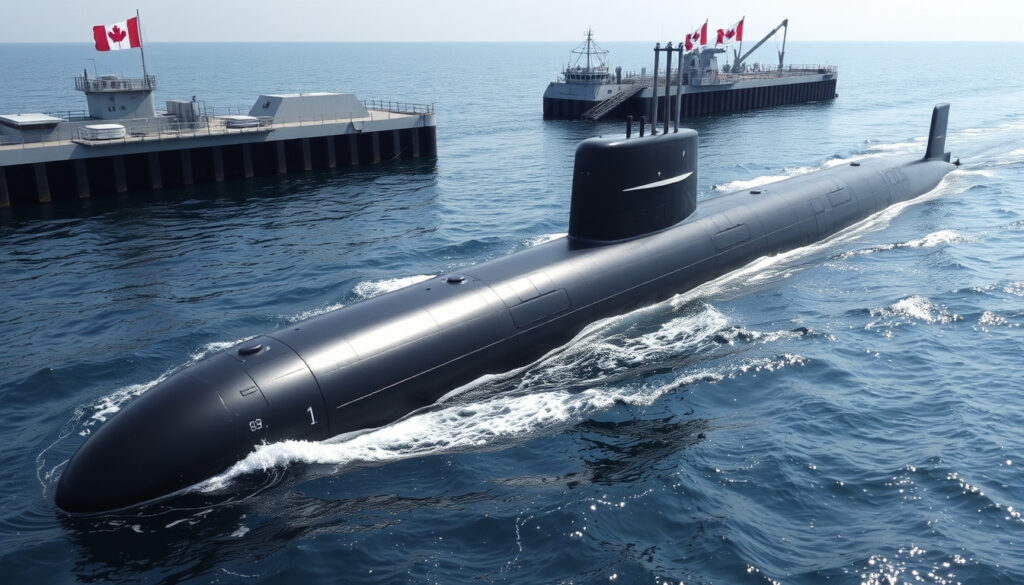
South Korea Submarine Offer Canada: KSS-III Bid Analysis
Canada’s navy operates just four submarines, and only one has been fully serviceable in recent memory. That’s a thin line of defense for the world’s longest coastline. South Korea’s Hanwha Ocean has brought its KSS-III submarine to Canadian waters in an aggressive bid to fill that gap — and the stakes are a $39.6 billion question.
Contract Value (Estimated): $39.6 billion CAD ·
Current Canadian Submarine Fleet: 4 (Victoria-class) ·
Bidders Remaining: 2 (Hanwha Ocean / TKMS) ·
Bid Deadline: November 2024 ·
New Submarines Planned: 12
Quick snapshot
- Two bidders remain: Hanwha Ocean (South Korea) and TKMS (Germany) (Global News)
- Canada plans to acquire 12 new submarines (Global News)
- KSS-III visited Victoria, BC in 2024-2025 for demonstration (Naval Technology)
- Which design will be selected by the Canadian government
- Exact timeline for contract award and first delivery
- Final number of submarines that will receive full funding
- KSS-III made a 14,000-km transit to reach Canada by May 2025 (Naval Technology)
- First delivery projected for 2032-2035 if Hanwha wins (Global News)
- Government review of bids through 2025 (Naval Technology)
- Contract decision expected in 2026 (Naval Technology)
- Industrial benefit negotiations between bidders and Canadian provinces (Naval Technology)
Here are the key numbers defining the contest.
| Metric | Value |
|---|---|
| Program Cost | $39.6 billion CAD (estimated) |
| Submarines to Be Built | 12 |
| Bidders | 2 (Hanwha Ocean, TKMS) |
| First Delivery Target | 2030s |
| Demo Visit | KSS-III arrived in Victoria, BC (2024) |
| Current Operational Submarines | 1 (of 4 Victoria-class) |
What does Canada get from South Korea?
South Korean submarine deal and bilateral trade relations
Hanwha Ocean is offering the KSS-III submarine, a 3,000-ton class vessel already in active service with the Republic of Korea Navy. The company’s pitch goes beyond hardware: it includes maintenance facilities, training centres, technology transfer, and localized supply chains in Canada (Naval Technology).
Hanwha’s offer is not just a submarine — it’s an industrial partnership. For a country with a declining shipbuilding base, that could mean more than 12 hulls.
Glenn Copeland, CEO of Hanwha Canada, stated that the Canadian government explicitly asked for an investment case as part of the bid (Global News). The company offered to deliver the first four submarines with no modifications to the existing KSS-III batch design — a strategy that prioritizes speed over customization.
The trade-off: Canada gets proven, in-service technology faster, but with less opportunity to tailor the boat for Arctic patrol and extreme cold-weather operations that are unique to Canadian waters.
Who did Canada buy their submarines from?
Current Victoria-class origin (UK)
Canada’s current submarine fleet — four Victoria-class boats — was purchased from the United Kingdom in 1998, with the last vessel commissioned in 2004 (Global News). These are Upholder-class submarines originally built for the Royal Navy but never fully adopted. Canada bought them as surplus and refitted them for domestic use.
Hanwha Ocean (South Korea) vs. TKMS (Germany) bids
Two bidders remain in the Canadian patrol-submarine competition: South Korea’s Hanwha Ocean, offering the KSS-III, and Germany’s ThyssenKrupp Marine Systems (TKMS), offering either the Type 214 or Type 212CD design (Global News).
Here is a direct comparison of the two offerings.
| Specification | KSS-III (Hanwha Ocean) | Type 212CD (TKMS) |
|---|---|---|
| Displacement | ~3,000 tons (surfaced) | ~2,500 tons |
| Propulsion | AIP (Air Independent Propulsion) | AIP (fuel cell) |
| In service | Yes (South Korea) | Under construction (Norway, Germany) |
| Max crew | ~50 | ~33 |
| Torpedo tubes | 8 | 6 |
| Vertical Launch System | 6 cells (missile capable) | None |
| Builder | Hanwha Ocean (formerly Daewoo) | ThyssenKrupp Marine Systems |
| First delivery (if selected in 2026) | 2032-2035 | 2035+ |
The KSS-III is already operational and can arrive earlier. But TKMS has a longer track record with NATO navies, which may matter for integration with allied forces.
The implication: Canada faces a classic procurement dilemma — proven design vs. purpose-built. Hanwha’s submarine is ready; TKMS’s design could be more tailored but comes with longer lead times.
How many submarines does Canada have?
Current fleet: 4 Victoria-class
Canada currently operates four Victoria-class submarines, commissioned between 1998 and 2004 (Global News). However, maintenance issues have severely reduced availability. In recent years, only one boat was fully operational at any given time, leaving vast Arctic waters virtually unpatrolled.
Planned replacement: 12 new submarines
The Canadian patrol-submarine project aims to replace the four aging Victoria-class submarines with 12 new boats (Naval Technology). Under Hanwha’s proposal, the first four would be delivered by 2035, with the remaining eight following at a rate of one per year — completing the full fleet by 2043 (Naval Technology).
Canada is trying to go from a handful of unreliable boats to a serious submarine fleet in just over a decade. That’s ambitious — and expensive.
What is the KSS-III submarine?
KSS-III design features
The KSS-III (also known as the Dosan Ahn Changho class) is a diesel-electric attack submarine built by Hanwha Ocean, formerly Daewoo Shipbuilding & Marine Engineering. It displaces over 3,000 tons when surfaced and features Air Independent Propulsion (AIP), allowing it to stay submerged for weeks without surfacing (Naval Technology). One of its distinctive features is a vertical launch system (VLS) with six cells, capable of firing land-attack and anti-ship missiles — a capability rare in conventionally powered submarines.
How it compares to competitors
The Republic of Korea Navy submarine ROKS Dosan Ahn Changho arrived at Canadian Forces Base Esquimalt in British Columbia on May 23, 2025, after a 14,000-kilometer transit from Jinhae Naval Base that began on March 25, 2025 (Naval Technology). This was not just a courtesy visit — it was a live demonstration that the boat can reach Canadian waters and sustain long-range operations.
“The KSS-III submarine displayed in Victoria was described as the type that would be delivered to the Royal Canadian Navy if Hanwha won, with an arrival time of 2032.”
Global News
What’s confirmed — and what’s not
Confirmed facts
- Canada has 4 Victoria-class submarines (Global News)
- 2 bids received from Hanwha Ocean and TKMS (Global News)
- KSS-III visited Canadian waters in 2024-2025 (Naval Technology)
What’s unclear
- Which design will be selected
- Exact contract timeline
- Final number of submarines funded
Timeline: Canada’s long road to a new submarine fleet
- 1998 — Canada purchases 4 Victoria-class submarines from UK (Global News)
- 2004 — Last Victoria-class commissioned
- 2020 — Canada launches new submarine procurement process
- November 2024 — Bid deadline for new submarine contract
- 2024-2025 — KSS-III submarine visits Victoria, BC for demonstration (Naval Technology)
- 2026 — Expected contract award (Naval Technology)
- 2032-2035 — First submarine delivery target
- 2043 — All 12 submarines delivered (if Hanwha wins)
Canada’s current submarines are nearing the end of their service life. Every year without a decision is a year the fleet gets smaller. The timeline leaves little room for delays.
For a detailed breakdown of the technical specifications and strategic implications, see Hanwha Oceans KSS-III bid analysis.
Frequently asked questions
How many submarines does Canada currently operate?
Canada operates four Victoria-class submarines, but maintenance issues have left only one fully operational in recent years (Global News).
What is the KSS-III submarine’s range and endurance?
The KSS-III is a 3,000-ton class submarine with Air Independent Propulsion (AIP), enabling submerged endurance of several weeks. It recently completed a 14,000-kilometer transit from South Korea to Canada (Naval Technology).
Why does Canada need new submarines?
Canada’s four Victoria-class submarines are aging and only one is reliably operational. The country has the world’s longest coastline, including extensive Arctic waters that require submarine patrol for sovereignty claims and maritime security.
When will Canada decide on the submarine contract?
A decision is expected in 2026, after evaluation of bids from Hanwha Ocean and TKMS (Naval Technology).
Who is competing for the Canadian submarine contract?
Two bidders remain: South Korea’s Hanwha Ocean (offering the KSS-III) and Germany’s ThyssenKrupp Marine Systems (offering the Type 212CD or Type 214) (Global News).
Does the KSS-III have missile capability?
Yes. The KSS-III features six vertical launch system (VLS) cells, capable of firing land-attack and anti-ship missiles — a rare feature for conventionally powered submarines.
What industrial benefits does Hanwha offer Canada?
Hanwha’s bid includes maintenance, repair and overhaul facilities, training centres, technology transfer, and localized supply chains in Canada (Naval Technology).
How long will it take to build all 12 submarines?
If Hanwha wins the contract in 2026, the first four submarines would arrive by 2035, with the remaining eight delivered at a rate of one per year, completing all 12 by 2043 (Naval Technology).
Related reading
More related posts
 Storm Reid: Why She Left Euphoria, Relationship, Career
 Tory Lanez Sentence: How Many Years Will He Serve
 20000 CAD to INR – Current Rate and Conversion Guide
 Noah Dobson: Injury, Contract, Wife & Career Stats
 Jessica Campbell Leaves Kraken: What Happened and What’s Next
 Toronto Maple Leafs Lineup Tonight: Injuries & Projected Lines
 Canada Post Strike Today: Status & Delivery Updates
 Potato Bacon Soup Recipe – Easy Step-by-Step Guide